

“Overlapping elections will lead to less scrutiny, less accountability, and it’s not in the public interest.”
—Cori Ramsay
In light of rumours Premier David Eby is poised to call a snap election this weekend, B.C. mayors and councillors are calling on his administration to “respect local government” and back off until after the municipal elections are complete on Oct. 17.
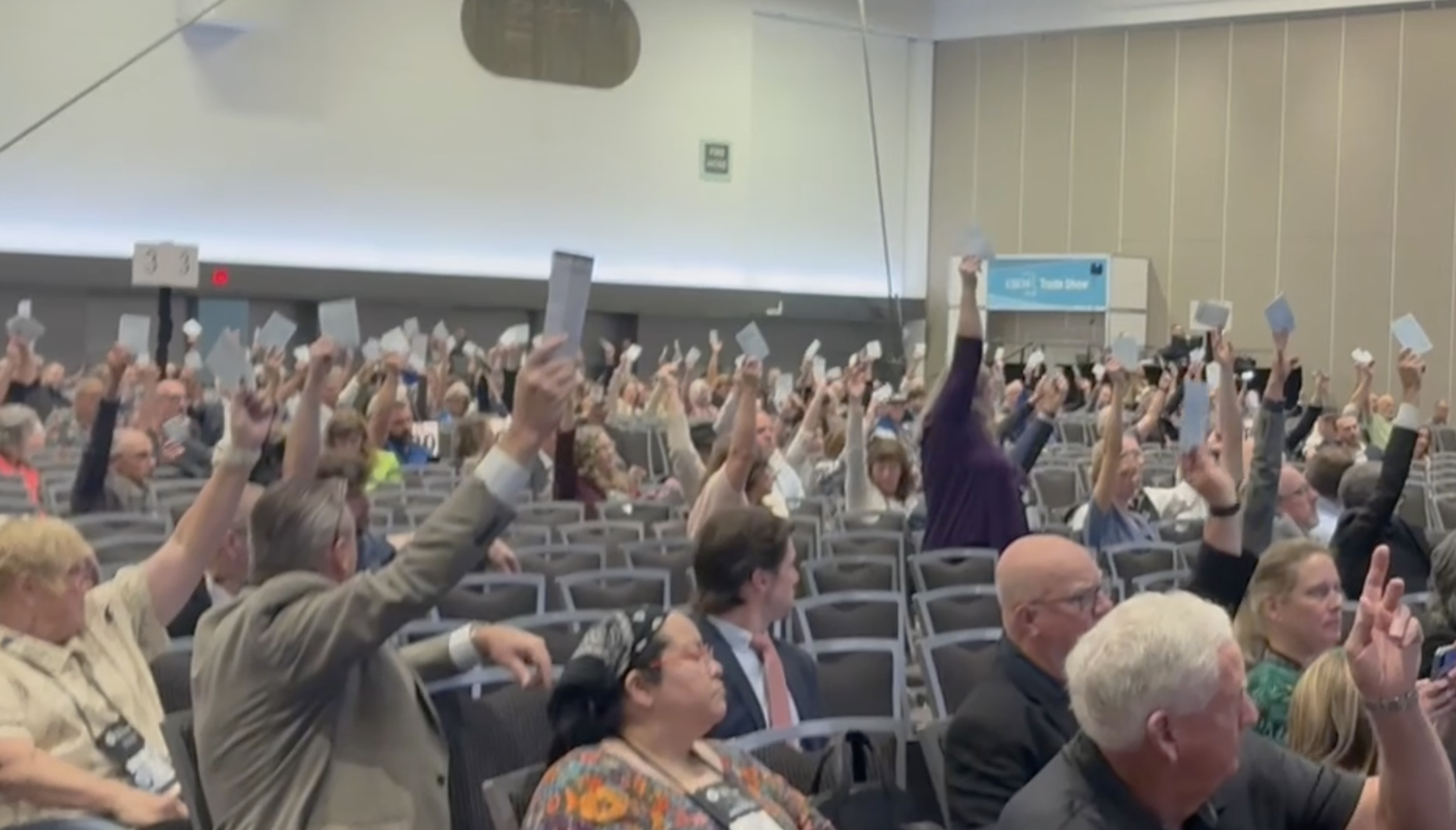
In a highly unusual move at the Union of British Columbia Municipalities’ annual convention, an emergency resolution interrupted the agenda. Mayors and councillors gave near unanimous support to a motion calling on the province to not trigger an early election during the municipal race to “preserve the integrity” of the process.
“UBCM is standing up for the public interest, and the public interest is not at all served by an overlapping provincial election,” UBCM president Cori Ramsay told reporters today. “Our communities do not want that. Our voters do not want that. We urge the premier to do the right thing and wait until local elections conclude on October 17.”
The primary concern is about protecting the integrity and effectiveness of local democracy, Ramsay said.
“It’s two conversations at one dinner table. It’s noisy. It’s hard to understand, and only the loudest voices will be heard. News feeds only have so much room. Newsrooms only have so much bandwidth.
“Overlapping elections will lead to less scrutiny, less accountability, and it’s not in the public interest.”
Instead, of having the time and space to debate community issues and local priorities, discussions will be overshadowed by concurrent provincial campaigns, Ramsay said.
‘This is not right’
The emergency resolution calling on the province to respect separate election periods was endorsed by Ramsay and supported by the cities of Coquitlam and Richmond, after being flagged by past UBCM president Trish Mandewo.
“My campaign team told me this morning [about the rumoured election], and I was like, ‘This is not right,’” said Mandewo, a Coquitlam councillor, now running for mayor. Mandewo is known for her no-nonsense leadership during two terms as UBCM president. She repeatedly fought for local government interests, successfully getting the province to back down on several controversial policies affecting municipalities.
Mandewo asked her team to research provincial legislation around respecting election dates of different levels of government and “immediately we knew that we had to do something,” she said.
Ramsay wrote a statement signalling UBCM’s opposition, but Mandewo felt municipalities needed to go further to make the province understand the strength of their opposition to the idea. Local government elections already get low voter turnouts and candidates must work very hard to engage and inform voters, she said.
“[The province] needs to respect that local governments need this time to have their election… and they can do [theirs] afterwards.”
Mandewo, her team, and fellow Coquitlam councillor Dennis Marsden worked furiously this morning to draft the resolution. Since Mandewo is on the UBCM executive, she is not permitted to bring motions forward, so Marsden stood up with Richmond councillor Alexa Loo, to present the resolution.
Representatives from about 10 different communities weighed in and the resolution won near-universal support.
Concurrent elections will confuse voters, says councillor
The municipal election is 30 days away, said Loo, who is running for mayor in Richmond. “They should be waiting until we are finished our process before they disrupt and create their own process. It’s only fair. It makes more sense, and it supports the democratic process.”
Loo has seven competitors running for mayor and Richmond has 55 people running for eight council seats, she said. “So there’s already a lot of work [for voters] to go through to get to know your candidates, to understand the issues, and to think about what’s happening,” she said.
Alexa Loo presents an emergency resolution calling on the BC government to back off on a snap election in the same time frame.
In any local government election, community issues can get drowned out by provincial concerns. Loo says here door-knocking team has already encountered people unaware there is even an municipal election taking place.
“They’re already trying to figure that out. If you layer on top of that more confusion as to who’s running [provincially], what they’re doing, who they’re with, what’s happening… you’ve got [provincial candidate] signs everywhere, you’ve got ads everywhere, you’ve got mass confusion.”
In previous instances of overlapping elections, it’s the local government elections that suffered very low voter turnout, said Loo.
“If we really want to support the democratic process, we need to allow people, residents, the time and the space to consider their vote and to get out and vote.”
Overlapping elections will interfere with building strong municipalities
Coquitlam’s Marsden said there is also the logistics on the administrative side to consider, including staff management of advance polling and election day voting booths.
“The delivery and execution is challenging,” he said. “We struggled to get the staff necessary to run an election properly, and now we’re going to divide the number of staff available to do this.”
If it was difficult to pull together the organization in Coquitlam, a city of 170,000 people, imagine the burden on a small community, Marsden said.
“Where are they going to get those folks who are able to step forward and run advanced voting days on the same day, as an example, so the conflicts in this are incredible.”
This really comes down to showing respect for municipalities, he said.
“If you want to enable us to move forward, put together good, solid candidates and ensure that our municipalities are well done, you can’t interfere with an overlapping election.”