

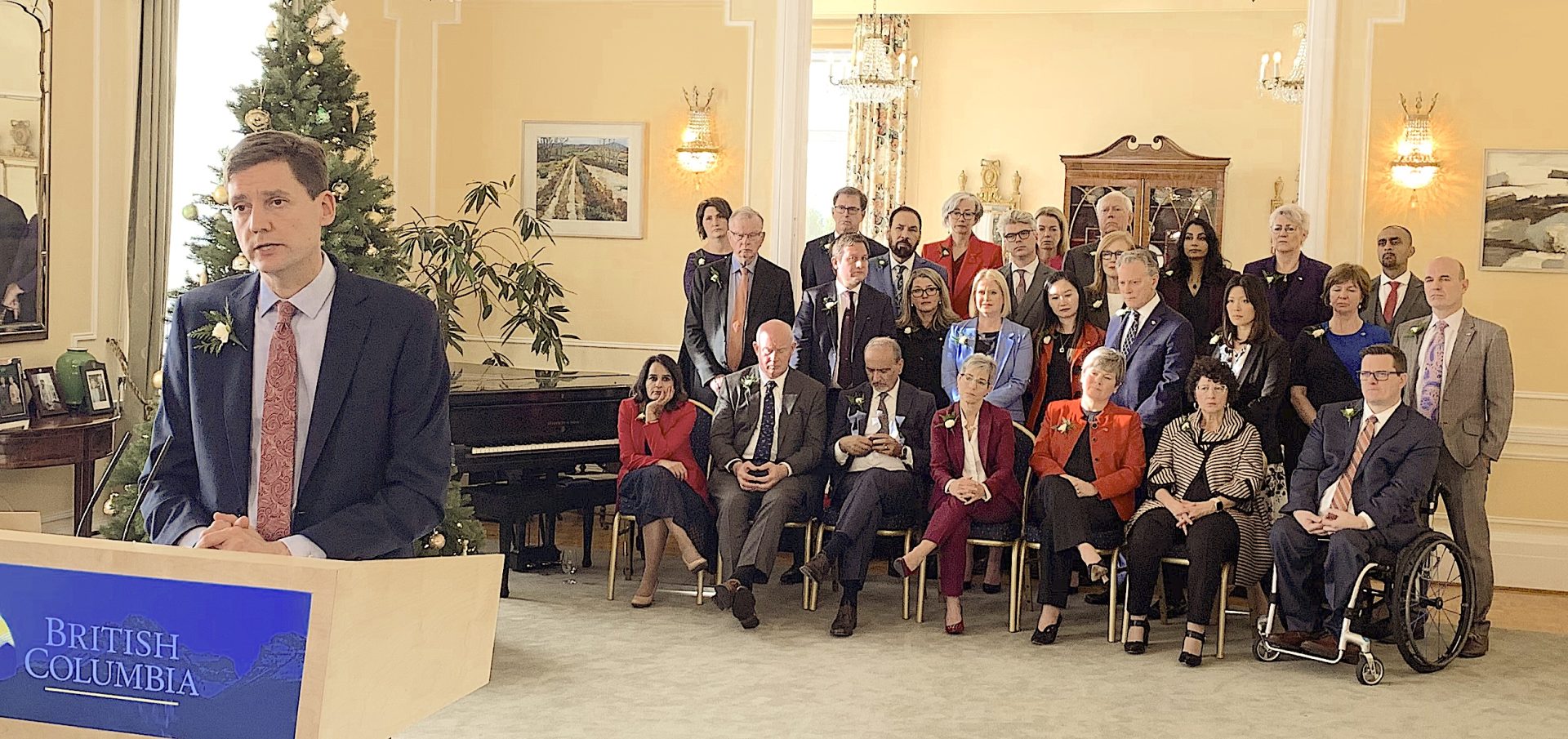
“It seemed like a game for him, treating folks across the aisle as avatars needing to be humiliated and defeated.”
—Selina Robinson
In November 2022, after John Horgan stepped down as BC NDP leader and premier, his successor moved me from my post as Finance minister—despite having delivered two surplus budgets— to the Ministry of Post Secondary Education.
The message was clear, David Eby didn’t like me.
Much as the demotion cut, it wasn’t unexpected, and I was determined to not let it affect my new job. So I plastered on the biggest smile I could muster and decided to be the best damned minister of Post Secondary Education the province ever saw.
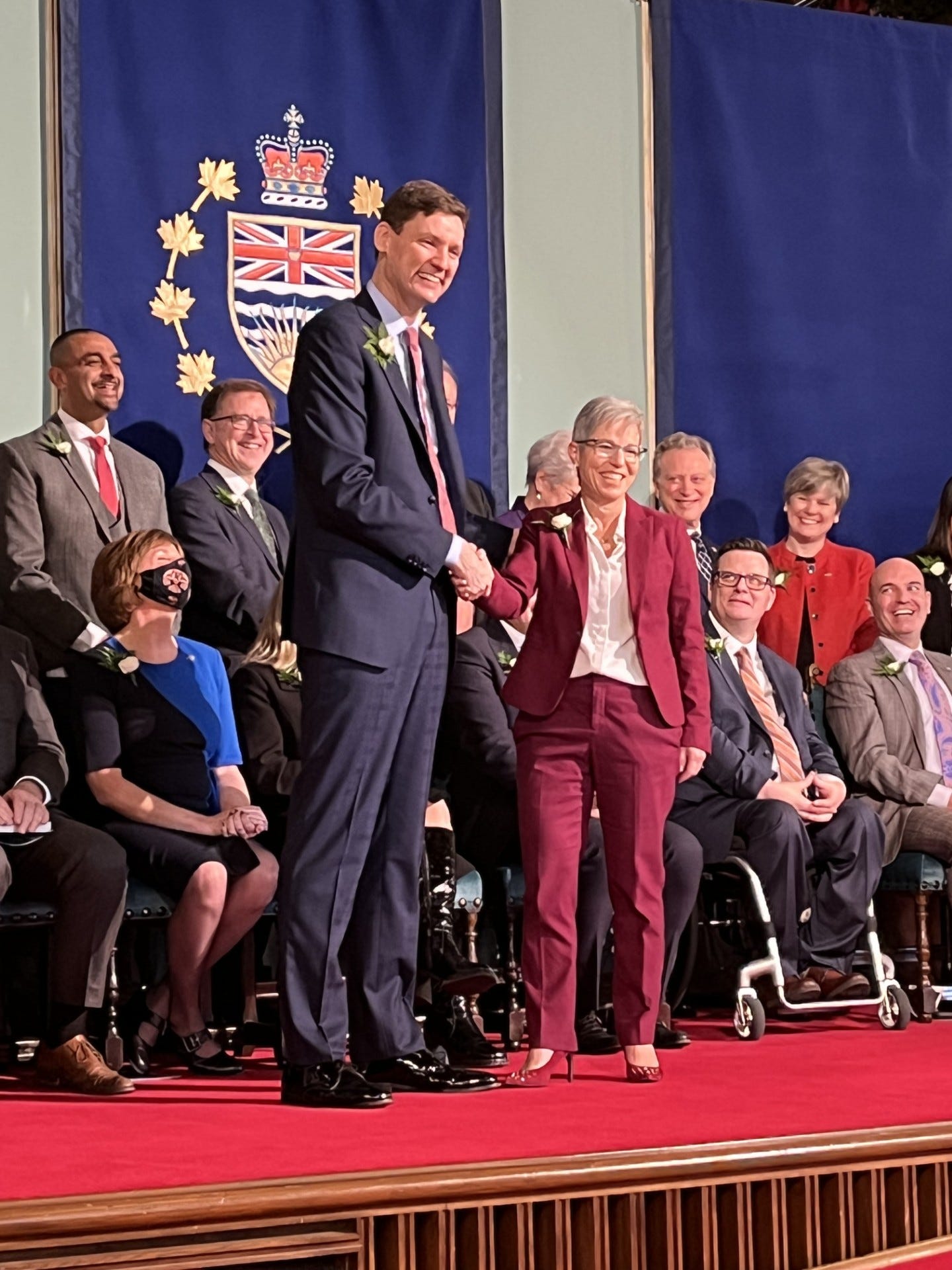
David was never my choice for leader.
In the early days after John Horgan announced he would step down, Davd asked for my endorsement of him as leader. I told him I was going to sit the race out. As Finance minister I said I needed to stay neutral while putting together a budget and working with all colleagues during a leadership campaign. What I didn’t share was that his leadership style didn’t jive well with me and I had already made my decision not to run in the scheduled 2024 election. My plan was to work with whomever was leader for the rest of the mandate and retire in October 2024.
This wasn’t the first time David asked for my endorsement as leader.
In the fall of 2013, just a few months after we were both elected for the first time, Adrian Dix stepped down as leader. Soon after, David came to my office informing me that he intended to put his name forward for leader. I was a bit stunned given we had both only been MLAs for what felt like five minutes. We didn’t even know where the bathrooms were in the Legislature and he was gunning for leader.
At the time, I thought that was plenty of chutzpah. I told him it was too early for me to endorse anyone, that I wanted to see who else might be interested in the leadership. Within weeks, David called to say he had changed his mind, that he had just learned that his partner was pregnant and the timing for leadership no longer worked for him. Even though he withdrew, I saw his ambition back then and the hubris that came with it.
Attacking opponents seemed like a game
Over the years, we had had some run-ins as colleagues in Cabinet that made me think he didn’t have what it took to be a leader who can work in a team, or bring out the best in his caucus members and appeal to voters. In my experience, he was not particularly grounded in a consistent set of values, and made panicked, shoot-from-the-hip decisions. While a smart man, he was not always the smartest. A political animal with little to no humility, David seemed mostly interested in beating up the opposition, acting on his ideas and retaining power, regardless of the cost—as last month’s election results showed.
I document some of these experiences in my book Truth Be Told, but there are other, additional stories that didn’t get included in the book that speak to the former premier’s style of engagement.
Often, after a long week in Victoria, a dozen or more MLAs would be waiting for Helijet flights back to the lower mainland. Many of us would shoot the shit with each other. BC NDP MLAs on one side of the terminal with BC Liberal/BC United MLAs on the other. We would sometimes chat about funny moments in the Chamber or upcoming community events. David rarely participated, choosing instead to stand apart, by the departure door, earbuds in, practicing his Mandarin. It was as if he didn’t like any of us, had nothing to contribute or had more important things to do than actually talk with the people he worked with. He is not a people person.
Neither did he like it when you disagreed with him.
Once, when he was Attorney General and I was minister of Municipal Affairs, he hung up on me, angry that i’d signed off on a consultation process on what he’d misunderstood as a final decision. And he certainly wasn’t happy with me when then premier Horgan removed him from Treasury Board during my tenure as minister of Finance. I also learned, years after the fact, that David had tried to organize colleagues to demand that John Horgan not task me with the Finance file after the 2020 election. Others shut him down, recognizing his hubris back then and pointing out it is the Premier that chooses cabinet.
While these incidents were irritating rub spots for me, it’s the way he responded to dug up-‘dirt’ on the opposition that I think speaks more deeply to his character and style of engagement. When the BC NDP research team would find some tidbit of information that might reflect poorly on a member of the opposition, David was often first in line to hurl accusations crafted to impugn and damage character.
It seemed like a game for him, treating folks across the aisle as avatars needing to be humiliated and defeated, rather than people who had different ideas. I always found this distasteful and what we saw in the latest campaign certainly reflected this kind of character assassination style of politics. The ongoing regular attacks on opposition candidates, campaign leadership and even candidates’ financial agents was not only distasteful, it is damaging our democracy-
Candidate attacks and character smears hurt democracy
Putting your name forward to run in an election is a big deal. It takes courage, a ton of energy, and a willingness to be challenged on your ideas. Your history is reviewed and vetted both by your own party and by the opposition party and things can come up that are taken out of context or don’t acknowledge that people grow and change—the views you held 10 years ago, are not necessarily the same ones you hold today.
Even then, it’s one thing to question a candidate who put their name up for public office, but attacking financial agents who are campaign volunteers, in an attempt to discredit the candidate and the party goes too far. Attacking people in an attempt to discredit them, taint the candidate and sink the competition harms our democracy and deflects debate away from policy.
Given the vitriol, the innuendo and the risk, why would anyone put their name forward to run for office? Why would anyone even volunteer to help out on a campaign?
This character assassination tactic demands purity of thought and action; it demands that peoople must be dismissed from their roles, fired as candidates, and diminished as human beings. It’s not only distasteful and mean, it’s harmful.
I know what that feels like because it happened to me.
When I was fired from cabinet for careless, if accurate, words I said on a podcast, it no longer mattered the skills i brought to the job, my accomplishements as a minister and what good I had done in the past, The only thing that mattered was words taken out of context and interpreted to an extreme in order to silence me.
While the victor who hurled the accusation takes a victory lap, our democratic process is eroded. And it appears that David had no problem repeatedly encouraging and participating in these acts designed to humiliate, destroy and silence, regardless of the person in his sights and no matter the cost.
A more humble leader would have stepped aside
That is not the BC NDP I signed onto in 2012.
Aside from this purity test and vitriol that dominated this election, the whole rationale for even calling the election was more about Eby saving his own skin, than it was about getting a mandate. I had been hearing scuttlebutt for some time that folks in the party and caucus were unhappy with the direction David had taken the party and government. He almost lost the 2024 election. He didn’t deliver on some big election promises and had racked up the largest deficit and debt in B.C.’s history, despite the surplus that he was handed when Horgan stepped down as premier and I was Finance minister. New Democrat insiders were chattering last summer and into the fall that perhaps it was time for a new leader.
A humble, thoughtful leader, upon hearing the chatter might have stepped aside.
A leader who cared about the larger project and not just their own viability would have stepped down last year so that a new leader could be identified and could reshape government so it was poised to continue governing in a way that better met the needs of British Columbians.
It doesn’t feel like a coincidence that the government offered the BCGEU a new healthy contract on Oct. 26, 2025, just three weeks before the BC NDP convention. The timing feels suspect—a way to ensure David would continue to have the backing of the labour movement at the upcoming convention, so that his leadership would be ratified for another two years.
The snap election—why now?
David has demonstrated he doesn’t have much patience or respect for local governments. He overrode them on several pieces of legislation and chose to not heed their entreaties to not hold overlapping elections.
The result: many local government leaders, influential people in communities around the province, spoke ill of David Eby and the BC NDP. And there was tremendous confusion when it came to voting. People didn’t know who their candidates were, which election signs were provincial versus municipal, or even where to vote for which election and when. All of which caused election fatigue and frustration, and the lowest provincial voter turnout in decades.
Had David Eby waited until after local government elections, he would have seen by the results the electorate is unhappy. In the lower mainland we saw a significant turnover around council tables which wasn’t a wholesale swing from one side of the political spectrum to the other, but more where the old guard got dumped and new blood was brought in. It was a change election—people were not happy with the status quo and wanted something different—an indicator the current BC NDP was likely to get booted as well.
It also never became clear why David needed to call the election now.
At first, he said it was to deal with Trump; then it was to deal with a tenuous majority that required the government to rely on the Speaker to manage tie votes. Roly Russell, candidate for Kootney-Similkameen, conceded during an interview that with such a slim majority, dissatisfied BC NDP caucus members could easily threaten government by choosing to walk away from caucus, or veto a decision (this was shocking to hear), thereby halting legislation or even causing government to fall.
They had managed, albeit with these challenges, for two years, so why go to the polls now? David blamed the two empty seats resulting in a one-seat majority, but one of those seats is considered the safest New Democrat seat in all of British Columbia. It was a thin rationale for calling a snap election. Many incumbents and new candidates had limited financial resources built up in their riding association election coffers, a proper platform hadn’t been developed and the electorate was confused by two simultaneous elections.
One obvious reason David called the election this fall was because there was chaos in the Official Opposition ranks. In the months prior to the election call, the BC Conservatives were in disarray. Their recently elected leader Kerry-Lynne Findlay was part of a faction of the Conservatives holding extreme views and she took to firing those who were more moderate. A number of Conservative MLAs had walked away from their party to sit as Independents rather than serve under Findlay’s leadership.
The David Eby that I was familiar with, the one who relished kicking opponents while they are in shambles, didn’t hesitate to pick this time to call an election. Little did he know that the election call would galvanize the Conservatives under new leader Lorne Doerkson and ultimately backfire big time on Eby’s scheme to ‘kick them while they’re down.’
Lots of blame to go around
And finally, the campaign itself was pathetic.
I had no idea what the pitch was except that “Conservatives are to be avoided at all costs.” But if that was the case, then why call an election that could position Conservatives to form government?
David Eby never presented a vision, something to believe in other than “Please pick us because the other guys are worse.” The list of accomplishments he provided were almost all accomplishments achieved under John Horgan’s administration—from housing to daycare to capital projects. Yet David and the BC NDP campaign never acknowledged how the party under John’s leadership made things better for British Columbians. He never used John’s reputation as a good leader to help bolster the New Democrats. He didn’t even have the humility to recognize the good we had done under a different leader.
Even David’s address to his decimated caucus earlier this week was full of hubris as he topped up the apology for the outcome by noting that he had no regrets, that he’d made the right call on the election and would do it again.
This man has no humility and no willingness to learn from his mistakes. He should never lead anything. Ever again.
But the failure of the BCNDP is not just on David Eby. Where were my ex-colleagues? The party executive? I know that many of them have been unhappy with his leadership for sometime and that most of them didn’t want this election.
How could representatives of a party based on democratic values be so hoodwinked into giving up their voices? A dictatorial leader took them to the cliff, said “Jump!” … and they did. Perhaps my ex-colleagues feared retribution, after all, look what David did to me after the mob came for my head.
There is plenty of blame to go around. I hope the party can sort itself out, identify a new leader, and rediscover kindness and humility. British Columbians deserve at least that much.
The BC New Democrats definitely ‘“have a lot of deep work to do.”.
Reprinted with permission. For more thoughts from Selina Robinson, read her Substack: On Retirement, Politics and Jewish Life.