

“The complex challenge of determining which lands in British Columbia are Aboriginal title lands must not be resolved by political maneuverings.”
–Geoffrey Moyse
Last week’s precedent-setting BC Supreme Court judgment, recognizing Aboriginal title on 800 acres of commercial, industrial, Crown land and private property in the province’s densely populated Lower Mainland, has ignited a firestorm of controversy.
But things may get a lot worse if the province makes good on its promise to negotiate title with the Cowichan.
In Cowichan Tribes v. Canada (Attorney General), Justice Barbara Young ruled the Vancouver Island-based Cowichan Tribes proved Aboriginal title on a pre-confederation summer village site in Richmond, B.C. The decision has put a blinding light on the relationship between constitutionally recognized Aboriginal title and private fee simple property interests, jeopardizing the reliability of the private property system – particularly in British Columbia.
The area recognized as Cowichan Aboriginal title land includes $100 billion in infrastructure, according to the City of Richmond, as well as Crown land, private property, and the ports and warehouses for Amazon, Wayfair, Canadian Tire, UPS, the Vancouver Airport Fuel Authority, and others.
Cowichan claim area and Aboriginal title land

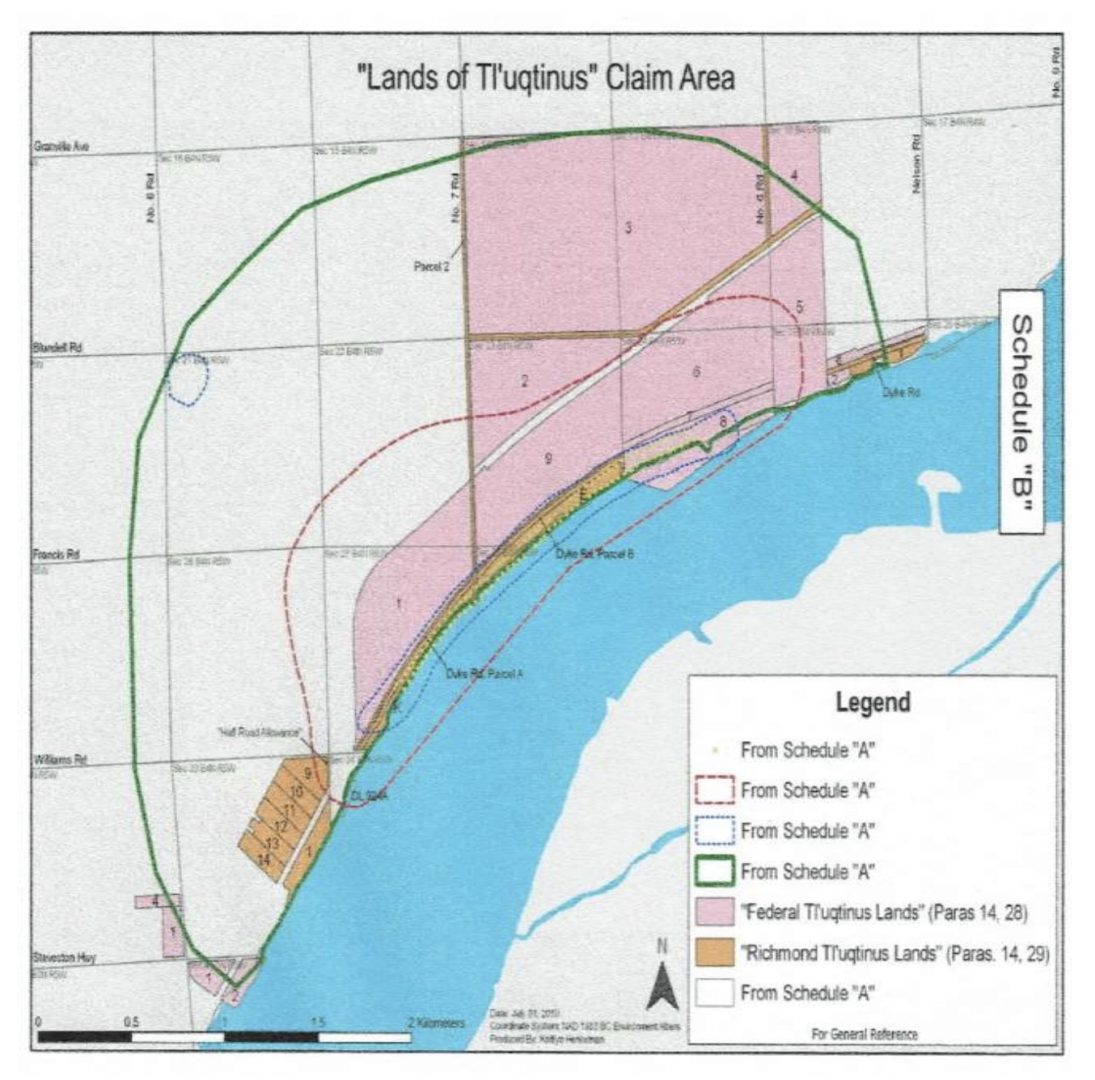

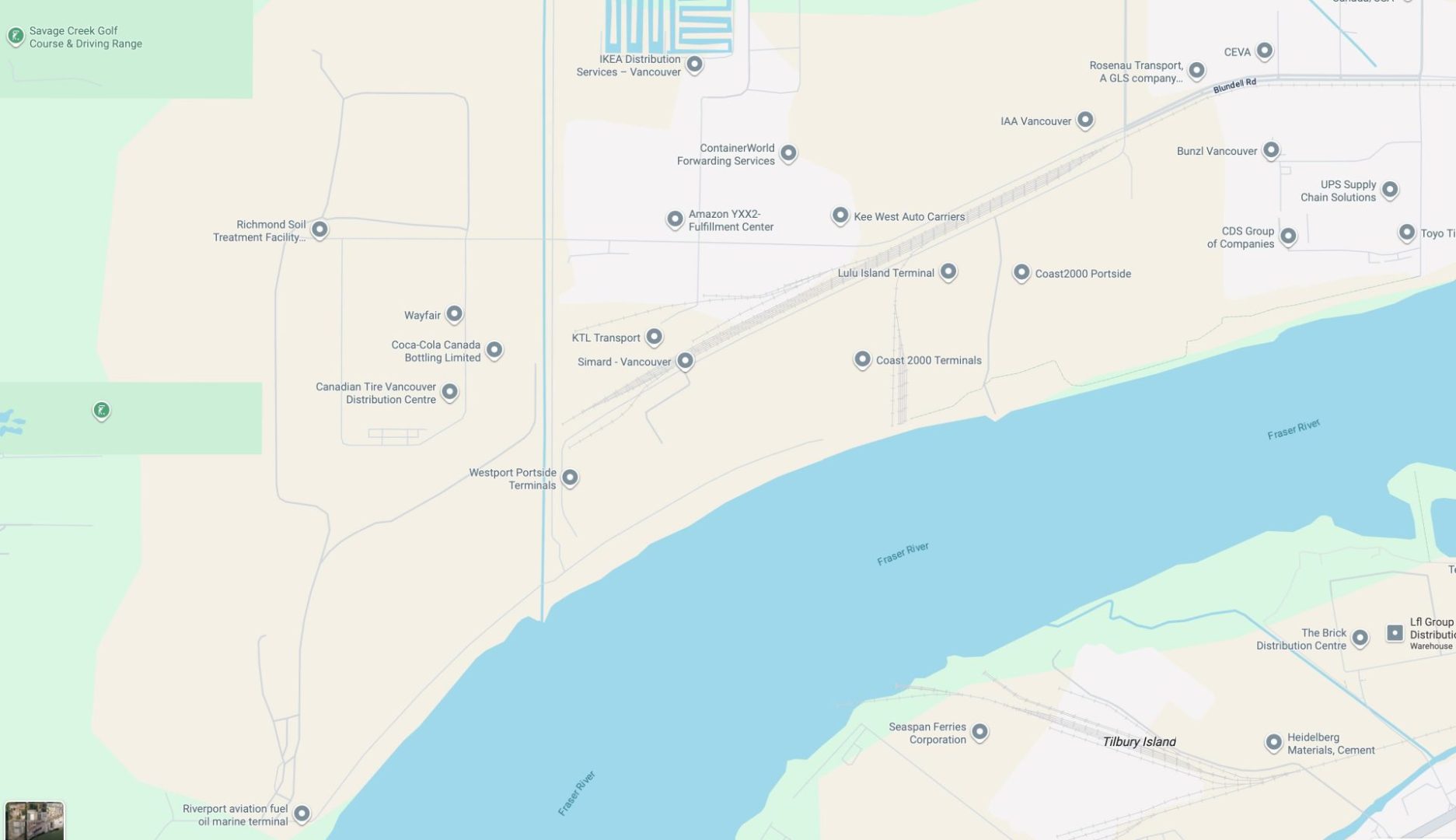
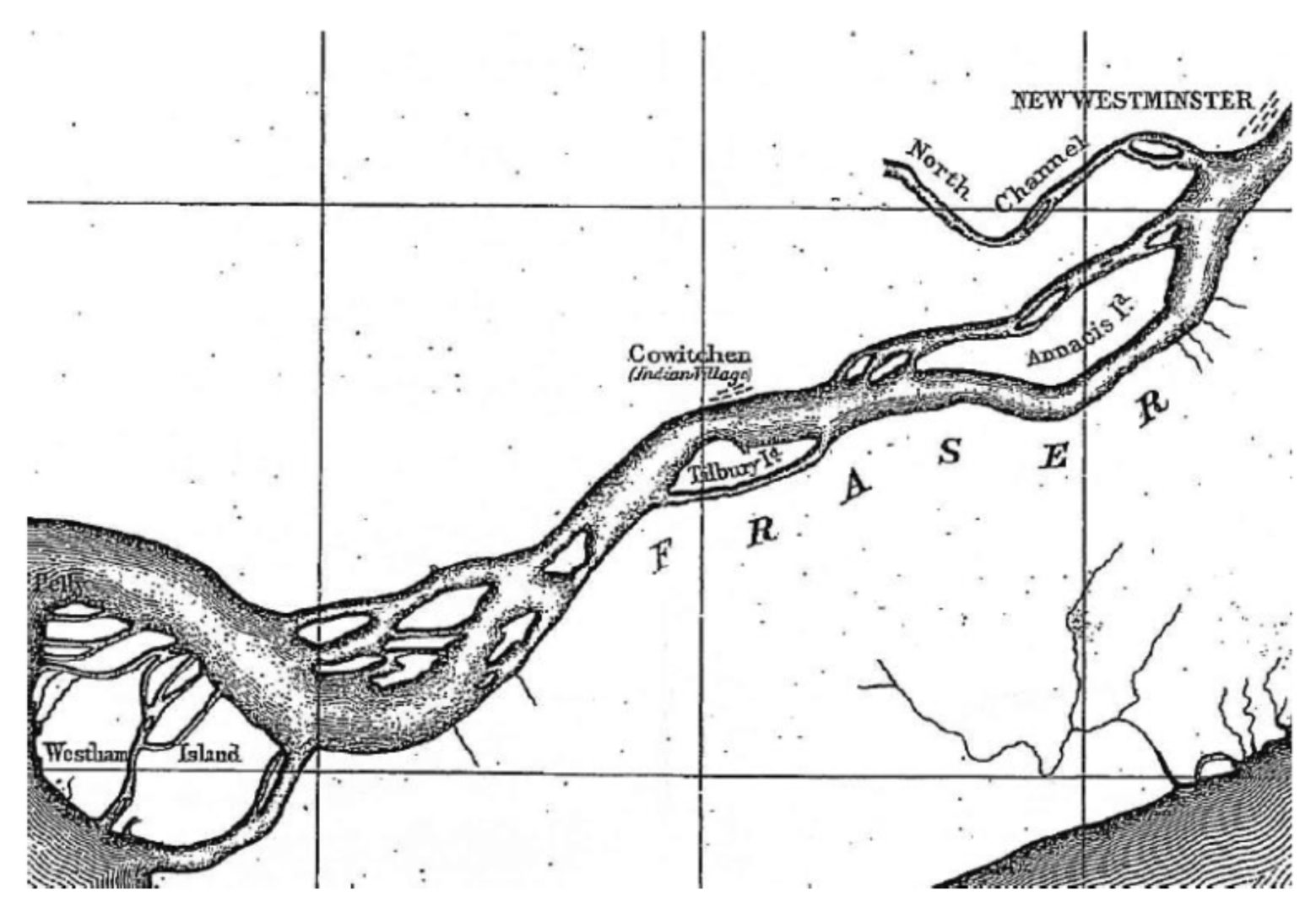
It is the third court decision finding Aboriginal title in B.C., but the first time Aboriginal title has been recognized in the court as co-existing with fee simple property rights. Private property rights are the bedrock of democracy, and are absolutely essential to the existence of the whole country and its economy. The two forms of title have not been tested in court against each other in terms of which takes precedence in land ownership.
Private property rights are bedrock of democracy, and absolutely essential to the existence of the whole country and its economy.
The unfortunate outcome of this court case is that despite the finding that Aboriginal title and private ownership can “co-exist,” the Cowichan can now use their title to evict the private land owners any time they choose.
Judge Young went even further in her judgment suggesting Aboriginal title takes precedence over municipal, private and Crown land and that all current day owners of the land were thus infringing on Cowichan Aboriginal title. Governments, she says, are now obligated to negotiate an agreement with the Cowichan to compensate for the infringement or return the land to the tribes.
In the latter case, compensation might take some form of financial accommodation for the infringement or government could possibly expropriate the land and return it to the Cowichan.
Government won’t say how far it will concede ‘land back’ demands
After some delay, Attorney General Niki Sharma announced the province will appeal the Cowichan decision. In her announcement of this intention, Sharma said “this case is an example of why the province prefers to resolve land claims through negotiation and not court decisions.”
“This case is an example of why the province prefers to resolve land claims through negotiation and not court decisions.”
Niki Sharma
When a reporter pointed out ‘land back’ – the premise that all Canadian land was stolen from Indigenous people and must be returned – is an integral part of the reconciliation process for some groups and asked the attorney general where her government drew the line, Sharma nodded, then skirted the question.
Instead, the minister vaguely referenced the “many examples” where “by sitting down with First Nations, we’re able to come up with reconciliation agreements, fulfilling our constitutional commitments, while removing uncertainty with respect to private land owner interests or any other interests on the land.”
If that was an attempt by the attorney general to reassure the public, it did anything but.
The BC NDP government’s “reconciliation agreements” have taken a myriad of forms – which the public has largely learned about after-the-fact, if at all – from majority ownership in resource development projects to joint or sole decision-making and title over Crown and private land.
“We have a couple of other examples of First Nations where we reached reconciliation agreements, and part of the agreement was to give the nation essentially title over the [provincial] park,” then environment minister George Heyman told BIV in 2024.
Haida agreement is BC NDP template for negotiating Aboriginal title
The best current example of how things turn out when this government negotiates Aboriginal title rather than pursuing the issue in court, can be seen on Haida Gwaii.
When the BC NDP government announced the Gaayhllxid • Gllhlagalgang “Rising Tide” Haida Title Lands Agreement on April 14, 2024, many members of an understandably legally uninformed public celebrated loudly about the wonderful outcome of Haida Aboriginal title being accorded over the totality of the Haida archipelago and large areas of the surrounding ocean.
The federal Trudeau government announced a similar agreement on February 17, 2025, between Canada and the Haida entitled the Chiix̲uujin / Chaaw K̲aawgaa “Big Tide (Low Water)” Haida Title Lands Agreement. The federal agreement is closely modelled on the provincial one with differences related to federal versus provincial constitutional jurisdiction.
The BC NDP government legislated – arguably unconstitutionally – the provincial declaration of Aboriginal title under section 35 of the Constitution Act, 1982, in the Haida Nation Recognition Amendment Act, 2024.
The federal government has yet to pass equivalent legislation to the provincial act which would be the only thing to save the provincial legislation from a successful constitutional challenge.
If the new federal government does legislate, the area described as Aboriginal title lands in the provincial “Rising Tide” agreement will likely receive constitutional recognition and affirmation. Embedded in constitutional concrete, it will become irreversible.
Courts have defined a test for proving Aboriginal title
Presumably, the Haida title agreement is one of the negotiating ‘success stories’ cited by Sharma as removing uncertainty for private land owners. But recognizing Aboriginal title to the nation’s entire claim over the whole of the lands and waters of Haida Gwaii (including private property, with some legally suspect protections) isn’t much of a negotiation and gives scarce assurance to the public its interests are being defended.
The outcome also bears no relationship whatsoever to the law with respect to proving Aboriginal title in Canada under section 35 of the Constitution Act, 1982.
In both of its decisions in Delgamuukw v. British Columbia and Tsilhqot’in Nation v. British Columbia, the Supreme Court of Canada set down legal tests with respect to the proof of Aboriginal title under section 35.
In Delgamuukw a majority of the court said:
“In order to establish a claim to aboriginal title, the aboriginal group asserting the claim must establish that it occupied the lands in question at the time at which the Crown asserted sovereignty over the land subject to the title.” [Emphasis added]
“The aboriginal group asserting the [title] claim must establish that it occupied the lands in question at the time the Crown asserted sovereignty over the land.”
Delgamuukw court decision
In subsequent cases, the date of asserted sovereignty has generally been taken in British Columbia to be the 1846 Oregon boundary treaty.
In the Tsilhqot’in case, the Supreme Court laid out the elements for actual occupation of land that would ground a valid claim to Aboriginal title, saying:
“The first requirement — and the one that lies at the heart of this appeal — is that the occupation be sufficient to ground Aboriginal title. It is clear from Delgamuukw that not every passing traverse or use grounds title. What then constitutes sufficient occupation to ground title?” [emphasis added]
“It is clear from Delgamuukw that not every passing traverse or use grounds title.”
Tsilhqot’in court decision
“The common law perspective imports the idea of possession and control of the lands. At common law, possession extends beyond sites that are physically occupied, like a house, to surrounding lands that are used and over which effective control is exercised.
“Sufficiency of occupation is a context-specific inquiry … occupation may be established in a variety of ways, ranging from the construction of dwellings through cultivation and enclosure of fields to regular use of definite tracts of land for hunting, fishing or otherwise exploiting its resources.”
The Delgamuukw case noted the core of a claim to Aboriginal title in common law is actual “occupation” through the “regular use of definite tracts of land for hunting, fishing or otherwise exploiting its resources.”
Judge had doubts about Aboriginal title over all Haida Gwaii
On Haida Gwaii, it seems clear that Haida villages and village sites existing in 1846 would qualify as Aboriginal title lands. Similarly, areas of coastal land surrounding those sites used for hunting and fishing sites and acquiring resources such as the cedar that is clearly integral to Haida society, would perhaps also qualify.
But historical accounts of the Haida people generally do not present a picture of regular occupation of the whole of Haida Gwaii – in particular the vast and in many cases rugged inland areas of the islands. History seems to indicate that the Haida were to a very large degree people of the coast.
When in the Haida challenged the replacement of a provincial tree farm licence in court in 2000, the case went all the way to the Supreme Court of Canada. In 2004, the case led to the clarification of the law under section 35 in respect of the consultation and accommodation duties of governments when faced with as yet unproven claims to Aboriginal rights or title.
In 2001, at the trial level of that lawsuit, the Supreme Court Justice in Chambers Douglas A. Halfyard, had occasion to examine “voluminous” evidence with regard to the Haida’s position that they held title to the entirety of the land area covered by the tree farm licence – a consequence of their claim to title to the whole of Haida Gwaii.
Justice Halfyard had this to say about the Haida Aboriginal title claim to the tree farm licence:
“In my opinion, there is a reasonable probability that the Haida will be able to establish Aboriginal title to at least some parts of the coastal and inland areas of Haida Gwaii, and that these areas will include coastal areas of Block 6. As to inland areas of Block 6, I would describe the Haida’s chance of success at this stage, as being a reasonable possibility.
“Moreover, in my view, there is a substantial probability that the Haida will be able to establish the Aboriginal right to harvest red cedar trees from various old-growth forest areas of Haida Gwaii, including both coastal and inland areas of Block 6, regardless of whether Aboriginal title to those forest areas is proven.” [emphasis added]
“There are legitimate issues with respect to the Haida claim of Aboriginal title to the lands of Block 6, and particularly as to those [Haida Gwaii] lands that are more than one kilometre inland from shore.”
Justice Douglas A. Halfyard
“In making these statements, I am mindful of the essential elements that must be proved to establish a claim of Aboriginal title or other Aboriginal rights, as defined and described in Regina v. Van der Peet [1996] … and Delgamuukw v. British Columbia [1997].
“I recognize that there are legitimate issues with respect to the Haida claim of Aboriginal title to the lands of Block 6, and particularly as to those lands that are more than one kilometre inland from shore.” [emphasis added]
Clearly, the judge had doubts about the ability of the Haida to prove Aboriginal title to lands more than one kilometre from shore, based upon his consideration of the “voluminous” evidence in front of him and the legal test for Aboriginal title set out by the Supreme Court of Canada in the Delgamuukw case, and repeated later in the Tsilhqot’in case.
When the Haida tree farm case was considered in 2004 by the Supreme Court of Canada, the court had the following to say:
“For more than 100 years, the Haida people have claimed title to all the lands of the Haida Gwaii and the waters surrounding it. That title is still in the claims process and has not yet been legally recognized.”
“The Haida’s claim to title to Haida Gwaii is strong, as found by the chambers judge. But it is also complex and will take many years to prove.”
BC government’s selective memory of Haida court case
When the B.C. government announced the declaration of Aboriginal title for the Haida to the entirety of the Haida Gwaii archipelago, it left out the last part of Justice Halfyard’s conclusions on the evidence about the greatest strength of that claim being on land within a kilometre of the shore.
Rather, the BC NDP selectively quoted the Supreme Court of Canada, claiming only that the Haida had a “strong claim” to Aboriginal title. Nothing was mentioned in the government’s press release about the extremely important factual conclusions of Justice Halfyard that the strength of the title claim did not blanket the entire island and his acknowledgement there were “significant issues” related to a title claim on areas further inland from the coastline.
The government’s omission of the judge’s full assessment presented Haida’s claim of Aboriginal title across the island and archipelago as court-sanctioned, deliberately misinforming the public and owners of private land on the Islands.
Despite the Supreme Court’s observation that the Haida Aboriginal title claim is “…complex and will take many years to prove,” the governments of Canada and B.C. reached a quick and simple conclusion, as seen in the map attached to the provincial Haida title agreement.
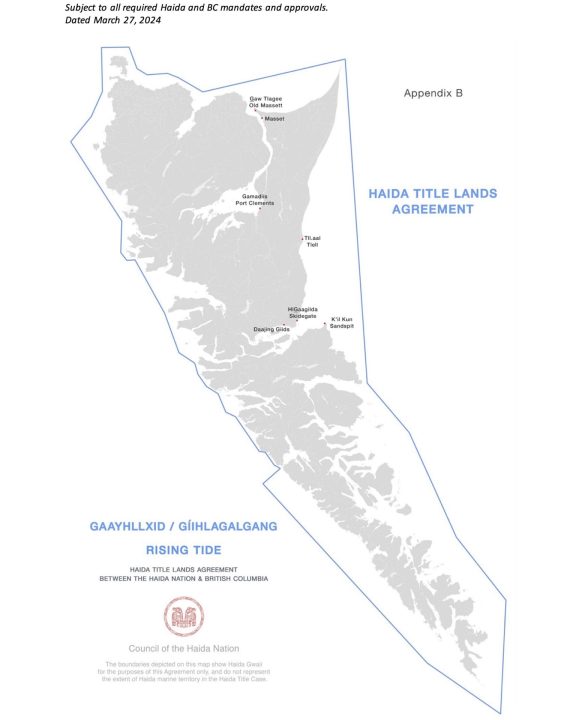
Once politics takes over from the law, a complex Aboriginal title claim can – Presto! – be as simple as drawing a polygon around the entire land and water area of the Haida Gwaii area. Apparently, the Haida regularly occupied every square inch of the more than one million hectares of land and sea in 1846 in a manner sufficient for the B.C. government to unilaterally declare Aboriginal title to the entire archipelago.
Recognizing title without proof breaches the public interest
This is the legacy achievement which B.C. Premier David Eby has touted as a template for the art of the possible on future declarations of Aboriginal title in the rest of the province.
No test for proof of Aboriginal title under Canadian law – and no recourse for the public – just draw a polygon around much of the totality of a claimed traditional territory and declare Aboriginal title to all the Crown and private lands within that claim area.
The B.C. public should demand the repeal of the Haida Nation Recognition Amendment Act, 2024 and insist the Eby government returns to the negotiation table with the Haida to determine Haida Aboriginal title properly in accordance with Canadian law. It’s also imperative that no other title agreements like the Haida agreement occur in British Columbia again.
Because the complex challenge of determining which lands in British Columbia are Aboriginal title lands must not be resolved by political maneuverings. It’s unjust and unsustainable to simply declare title wherever it happens to be claimed, without regard for Canadian constitutional law, private property rights and the larger public interest.
Without a clear, structured, legally sound and transparent negotiation process, creating Aboriginal title-by-politics just fuels societal divisiveness and engenders new inequities, opening the door to lawsuits of a different sort.
It’s no wonder then when Attorney General Sharma says the NDP government prefers to “negotiate” Aboriginal title and will follow up with the Cowichan, that many find the prospect alarming.