


Two weeks after leaders of the Drug User Liberation Front were convicted of possession of illicit drugs for the purpose of trafficking, B.C. Premier David Eby reiterated his government’s implausible claim it was unaware of the group’s illegal activities during the three years it received BC Health funding.
“As soon as we learned that DULF was involved in illegal activity and receiving government funding, we directed Vancouver Coastal Health to cut off the funding to this organization,” the Premier told reporters three different times in a press conference last week.
In truth, Jeremy Kalicum and Eris Nyx engaged in repeated, high-profile illicit drug trafficking precisely because they had the material support and complicit approval of B.C.’s senior health bureaucrats and elected BC NDP government politicians.
More than that, DULF owes its very existence to the coaching of ambitious taxpayer-funded health administrators, and the willful blindness and political benevolence of B.C. government officials.
DULF is born
In 2019, the BC NDP government funded a “safe supply” conference that fuelled the formation of DULF. Held at a high-end Pender Island resort, the conference brought together 40 drug users from across the province, along with select government-funded health researchers.
The highest profile among the group was former deputy provincial health officer and BC Centre for Disease Control executive director, Dr. Mark Tyndall, a UBC professor of medicine at school of population and public health, who has long been an fervent advocate for safe supply.
Also in attendance were Kalicum and Nyx, working for B.C.’s top health research and policy agencies, BC Centre on Substance Use (BCCSU) and BC Centre for Disease Control (BCCDC), respectively. According to a Time Magazine piece, this is where Kalicum and Nyx met and “bonded over their shared mission, and created DULF.”
The two-day, all-expense-paid conference on the government’s dime covered meals, hotel, flights, a safe consumption area, and even illicit drug procurement, courtesy of “peer navigators” for conference attendees who needed help sourcing substances while on the road.
A 2024 statement to Northern Beat, the Provincial Health Services Authority, which funds BCCDC, denied people were hired to source illegal drugs for drug users at its functions, however, Dave Hamm, a director from the Vancouver Area Network Drug Users (VANDU), a partner organization to DULF, recounted otherwise to the all-party B.C. legislative health committee in 2022.
“I was hired by the BCCDC to be an ethical substance peer navigator, meaning I was hired by them at 20 bucks an hour to go out and get good, clean, safe drugs for people that were attending their conference,” Hamm testified to the committee, chaired by now Attorney General Niki Sharma. Sharma was parliamentary secretary to then Attorney General David Eby at the time.
“I was hired by [BCCDC] at 20 bucks an hour to go out and get good, clean, safe drugs for people that were attending their conference.”
Dave Hamm
It’s unknown whether Hamm was referring to the 2019 safe supply conference attended by Tyndall, Nyx and Kalicum or if multiple BCCDC-sponsored events offered the drug-buying services of peer navigators.
The 2019 safe supply gathering was billed as being organized and led by people who use drugs. Nyx and Kalicum have each spoken publicly about using or having struggled with problematic substance use. The two drug user groups listed as event hosts were funded by BCCDC. Nyx, who was described as the event organizer and was listed as the conference contact person, was reportedly under contract to BCCDC at the time.
Conference panel discussions covered such topics as “options for peer driven and illicit models of safe supply” and “setting up establishments/dispensaries to distribute safe supply through established drug user groups and established OPS sites,” and “connecting people who have worked on establishing drug-buyer clubs,” to “supporting existing peer networks for supply distribution” and “how to promote the growth of a ‘verified dealer’ model.”
Discussions were also held on how to include more extreme opiates like fentanyl in safe supply projects; the legal ramifications of running illicit safe supply projects; what legal exemptions should be sought, and how medical professionals can help drug user groups in initiating peer developed models.
Essentially, attendees brainstormed on how to set up illegal drug-buyer clubs as outlined in a BCCSU compassion club paper published earlier in the same year, and modelled on the HIV/AIDS cannabis compassion club model exalted by Tyndall and his previous health policy influencer peers at BC Health and the UBC population and public health department alumni, among others.
Many of the conference attendees from drug user groups formed the first membership of DULF, although Kalicum and Nyx would go on to officially co-found the group and be the primary spokespeople, eventually becoming minor celebrities in drug user and harm reduction activist circles around the world.
DULF waged very public campaign for illicit safe supply
From DULF’s inception, the group brazenly and repeatedly flaunted the law, buying, testing and distributing illicit drugs purchased with cryptocurrency via the dark web. The leaders waged an impassioned public campaign on behalf of drug users for the legalization of all drugs and access to safe supply. They dubbed their illicit drugs “unsanctioned safe supply.”
“In the face of ongoing death in Vancouver’s [Downtown Eastside], DULF continues to hold out hope that overdose prevention services can be bolstered via novel drug supply regulation,” the group’s website read.
This dovetailed well with the overall, but generally publicly unknown, behind-the-scenes drug legalization agenda endorsed by many of B.C.’s top health administrators and elected government officials.

Between June 2020 and October 2023, DULF held more than 20 illicit drug giveaway events, numerous very loud rallies, parading through Vancouver’s Downtown Eastside streets, blocking intersections, music blaring, speakers on bullhorns, brazenly distributing illicit drugs to local residents in front of police and demanding action from government.
Kalicum and Nyx did dozens of local, national and international media interviews in print, radio, magazine and television.
The group also comprehensively chronicled its own media coverage and many illegal trafficking actions, such as its “dope on arrival’’ campaign on its own website. Dope on arrival was a staged event in which DULF organizers gave away pre-packaged illicit drugs, usually cocaine, meth and heroin to mark the deaths announced by the provincial chief coroner in her monthly overdose updates.
BC’s own public health agencies promoted DULF
Shortly after the group’s first public action on June 23, 2020, where DULF reportedly handed out 100 individual packages of cocaine and raw opium, the event was trumpeted on the government’s own BC Centre on Substance Use website. The province’s primary health research and policy agency, BCCSU continued to celebrate DULF’s many activist successes, tracking illicit drug giveaway events and other activities, including providing links to the group’s fundraising page and “compassion club” member survey study.
As early as April 2021, representatives from BC Health-funded Vancouver Coastal Health oversaw a safe consumption tent and BCCSU staff were on-hand at DULF rallies alongside where illicit drugs were distributed.
In mid-July, Vancouver city councillor, Jean Swanson, handed out heroin alongside DULF at a public event, which the BCCSU later amplified on its website. A couple of years later, Swanson donated $6,000 to the legal action fund to help defend Kalicum and Nyx on drug trafficking convictions.
The following month, on Aug. 31, 2021, DULF and its sister organization, Vancouver Area Drug Users Network (VANDU) partnered on a proposal to allow DULF, via VANDU, “to operate a Safe Supply Fulfillment Centre and Cocaine, Heroin and Methamphetamine (CHM) Compassion Clubs,” according to their 2021 joint submission to Health Canada. The two groups requested, and were later denied, an exemption to the Controlled Drugs and Substances Act so they could legally store illicit drugs on the premises.
“Historically, VANDU has partnered with DULF to distribute [cocaine, heroin, methamphetamine] safer supply to people who use drugs in Vancouver, and we hope to continue to build out this partnership and protect those most at risk of overdose death in our communities – in part, through the Safe Supply Fulfillment Centre and CHM Compassion Clubs,” the VANDU and DULF authors wrote.
“DULF’s proposal involves acquiring illicit drugs, testing them through existing community drug checking programs, labelling them, and distributing them.”
Dr. Mark Lysyshyn
The application for an exemption was fortified by letters of support from B.C.’s elite harm reduction ranks: Mark Lysyshyn, deputy chief medical health officer for Vancouver Coastal Health Authority; Dr. Martin T. Schechter, former co-director of BCCDC, co-owner of Fair Price Pharma, and UBC co-founder of the school of population and public health; Dr. Thomas Kerr, social medicine division head at UBC’s school of medicine and director of research at BCCSU; Leslie McBain, contractor with BCCSU and co-founder of Moms Stop the Harm; Cheyenne Johnson, executive director, BCCSU; Dr. Christy Sutherland, UBC medicine prof and medical director at PHS Community Services; Vancouver mayor Kennedy Stewart, former BC Green leader Sonia Furstenau, and more.
“DULF’s proposal involves acquiring illicit drugs, testing them through existing community drug checking programs, labelling them, and distributing them to members of the club. This proposal would increase access to drugs that have been tested through community drug checking programs,” wrote Lysyshyn, adding that his boss, Dr. Patricia Daly, the chief medical officer for Vancouver Coastal, “has recommended developing a safer supply of drugs and the piloting of novel forms of drug distribution such as via compassion clubs.”
Health authority begins funding DULF in 2021
The same year, BC Health, through Vancouver Coastal Health Authority, began funding DULF to test illicit drugs and run the overdose prevention site. From fiscal year 2021/22 until 2023/24, the health authority gave VANDU almost $3 million in total and DULF at least $540,000. How much, if any of DULF’s funding was diverted to purchase illicit drugs is unknown – despite protestations otherwise – particularly given Nyx’s joke-bragging to an Australian conference crowd in 2022.
Either way, since all overdose prevention sites are funded by the province and require criminal code exemptions to allow personal possession on the premises, every elected government official who was aware of DULF’s overdose prevention site knew the group was endorsed by BC Health and taxpayer-supported.
In March 2022, Health Canada rejected DULF and VANDU’s application for a Section 56 exemption to the Controlled Drugs and Substances Act, essentially because the drugs were derived from illegal sources. Undeterred, the two groups requested a judicial review of Health Canada’s decision and declared they would forge ahead anyway and pour resources into a “fulfillment and distribution centre” for its so-called compassion club.
Also on this date, DULF staged another illicit drug giveaway event, this time on the constituency office frontage of then-B.C. Health Minister Adrian Dix, where pouches of cocaine, heroin and methamphetamine were distributed. On the same day, DULF also mailed similar illegal substances to drug user groups throughout the province for them to “distribute” to their members.
DULF, VANDU tell legislators, health ministers about illegal activities
As of May 2022, Vancouver Coastal Health and Providence Health Care already had a “range of non-prescriber models that are being either developed, or are in place and evaluated right now,” said Dr. Réka Gustafson, then the Deputy Provincial Health Officer with responsibility for the BCCDC. Gustafson was since appointed vice president population health and chief medical officer for Vancouver Island Health Authority.
“One of the most important things that we can do right now is to support the rapid implementation and evaluation of non-medical models of safer supply,” Gustafson told legislators in May 2022.
In June 2022, several members from VANDU and other drug user organizations explained DULF and VANDU’s trafficking activities to an all-party B.C. legislative health committee. “DULF is buying drugs from the dark web and having them checked by three or four different services, boxing them up and letting people know what they are,” VANDU’s executive director Brittany Graham told legislators.
Sharma asked, “What does a compassion club look like? How does it operate? What are the benefits?”
To which, Graham replied, “we have been doing some safe supply events in our activism in the last two years, with the Drug User Liberation Front… so we said, “Well, if you’re going to be using our location and our name, we need to be involved in this.” Graham then referred legislators to the document VANDU and DULF had co-written, which defines compassion clubs as “drug-user led collectives whereby drugs are bought in bulk, tested for purity and contaminants, and distributed at a reasonable cost.”
The groups had been working with Dr. Thomas Kerr, research director with the BC Centre on Substance Use, developing a related research project, Graham said. Kerr is listed as the research lead on the fulfillment centre/compassion club study proposal and reportedly advised groups’ original submission to Health Canada.
When DULF and VANDU decided to go ahead with their compassion club study, guided by Kerr, “DULF contacted all relevant authorities at this time to notify them of the intention to run the [compassion club], with or without sanctioning. This included the federal and provincial Minister of Health, and the federal and provincial Minister of Mental Health and Addictions, it also included members of the Vancouver Police Department, and the Royal Canadian Mounted Police…” a 2024 research paper co-authored by Kalicum and Nyx stated.
“DULF contacted all relevant authorities [in 2022] to notify them of the intention to run the [compassion club], with or without sanctioning. This included the federal and provincial Minister of Health, and the federal and provincial Minister of Mental Health and Addictions.”
Eris Nyx and Jeremy Kalicum
According to Kalicum and Nyx’s 2025 BC Supreme Court ruling, on July 28, 2022, Vancouver Coastal Health Authority medical health officer Dr. Lyshyshyn had “on behalf of the BC Minister of Health” designated a storefront space free of charge to DULF for its compassion club and fulfillment centre and as an overdose prevention site. Two months later, Lyshyshyn designated the DULF site to be an Urgent Public Health Need Sites and granted it a s. 56(1) exemption for the collection, storing and testing of illicit drugs.
All this support of DULF’s illegal drug sales to compassion club members was justified by top health and elected officials who point to a study done by members under the guidance of Kerr.
Based on a series of self-reported surveys of drug user participants, the stated goals were to reduce overdose events and not cause adverse effects. The main result was that while a few people dropped out or disappeared, no compassion club members died from consuming DULF’s drugs and “enrolment in the compassion club was associated with reduced likelihood of non-fatal overdose.”
How they arrived at this conclusion was scientifically weak to say the least. Participants were paid to check in several times over a 14-month span and self-report whether they’d experienced an overdose, which 47 per cent said they had. Of those surveyed, 55 per cent reported diverting their drugs at least once. The recipients of the diverted drugs were not tracked.
Sharma: ‘I’m really curious about… compassion clubs’
On Sept. 7, 2022, Sharma again asked drug user group representatives testifying before the legislative health committee about compassion clubs.
“I’m really curious about learning about compassion clubs, how they show up and examples of them from your experiences,” Sharma asked witnesses from the Professionals for Ethical Engagement of Peers and People with Lived and Living Experience, a BCCDC and BCCSU joint committee of drug user groups across B.C.
“Right now there’s a wonderful organization called DULF, which is peer-led. It provides safe supply to people…” said Hawkfeather Peterson, a regional peer coordinator with Northern Health and president of the BC/Yukon Association of Drug War Survivors, one of the longest running drug user groups in B.C. and which has received substantial government funding over the last five years. Peterson was also a member of the federal government’s expert task force on substance use.
Another drug user advocate testified to the legislative committee that she wasn’t comfortable with DULF members referring to their drugs as “safe supply.” Charlene Burmeister, founder of the Coalition of Substance Users of the North said: “The reality is that [DULF’s] substances are tested, but they’re still bought out through the black market, and they still support organized crime.”
“The reality is that [DULF’s] substances are tested, but they’re still bought out through the black market, and they still support organized crime.”
Charlene Burmeister
Sharma’s only response was: “All right. Any other comments?”
Meanwhile, a day earlier in Vancouver’s Downtown Eastside, federal Addictions Minister Carolyn Bennett toured DULF and VANDU’s compassion club and so-called fulfillment centre. Then, on Sept. 28, 2022, DULF praised Bennett’s “bravery,” stating in a press release, “DULF applauds such a monumental moment of political leadership.”
DULF commemorated Bennett’s “historic” visit by distributing 10.5 grams of “community regulated” cocaine, heroin and meth.
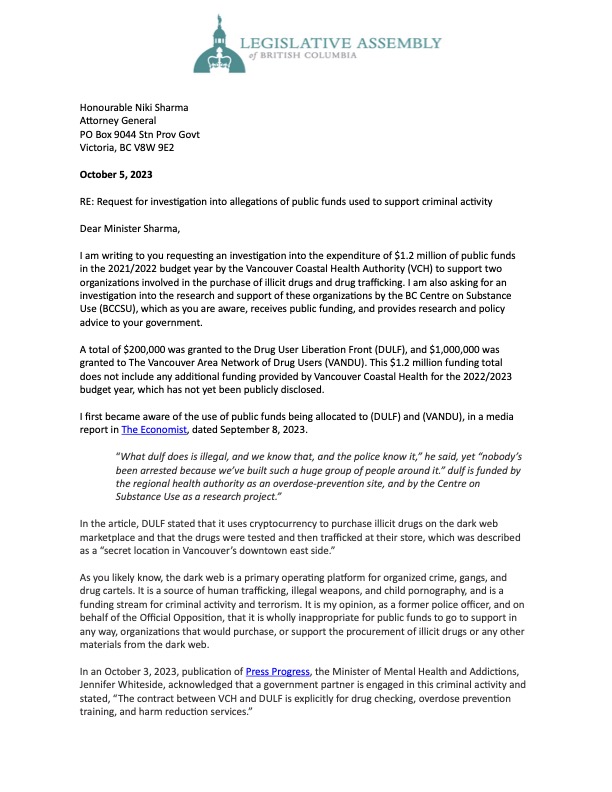
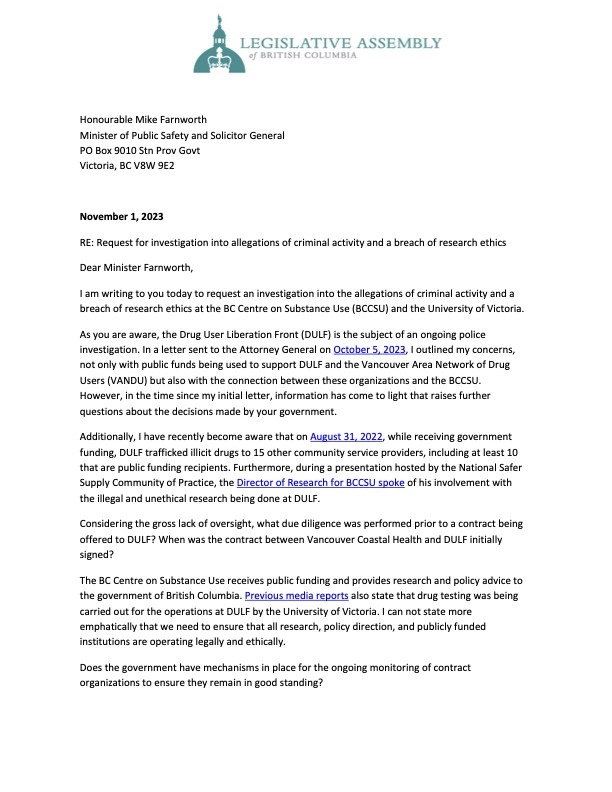
A year later, when the then BC United Addictions critic Elenore Sturko discovered DULF was being supported by taxpayer funding, Sturko wrote separately to Attorney General Niki Sharma and solicitor general Mike Farnworth, demanding a police investigation of who knew what when, along with an audit of where and what the government funding supported.
Sturko letters to Farnworth and Sharma
When the dust settles, two are left standing
Neither Sharma nor Farnworth, who is now Transportation minister, ever publicly acknowledged the illegal activities of DULF and neither have addressed Sturko’s requests for an investigation and an audit.
On Oct. 31, 2023 DULF’s funding was cut, while VANDU collected around $900,000 in 2023/24 from Vancouver Coastal Health Authority and an unknown amount of funding during the current fiscal year.
The premier and then Addictions Minister Jennifer Whiteside both deflected questions related to having any knowledge of DULF’s illegal drug trafficking activities. The Ministry of Mental Health and Addictions has since been disbanded and Whiteside was moved to Labour.
Health Minister Adrian Dix deferred all questions on DULF to Whiteside, despite his ministry having funded the group. Dix is now Energy minister.
UBCSU research director Kerr is on leave, and several other top health administrators who were architects of the compassion club model have all left the public health service.
Former chief coroner Lisa Lapointe, who used the last of her political capital to advocate for DULF on her way out the door, did not have her contract renewed. And Dr. Bonnie Henry, the current provincial health officer who served as deputy provincial health officer during Tyndall’s tenure, praised DULF’s compassion club model and its efforts to combat the drug crisis. After several times very publicly advocating for a non-prescriber safe supply model and the legalization of all drugs, Henry was sidelined by the Eby government and has all but disappeared from view.
DULF co-founders Jeremy Kalicum and Eris Nyx, meanwhile, were arrested, their homes were raided and both were subsequently charged and convicted of possession of illegal substances for the purposes of trafficking. Their sentencing has been paused pending the results of a constitutional challenge that is still before the courts.
“[Vancouver Health Authority] knew that DULF was distributing tested drugs when they… gave them funding…”
Madam Justice Catherine Murray
“They have always been openly and publicly forthright about their activities and their impetus for doing so. They spoke to police, politicians and health officials about their activities. They copied police and public officials on correspondence and invited them to their meetings,” wrote the Madam Justice Catherine Murray in her November 2025 Rex v. Jeremy Kalicum and Eris Nyx ruling.
“[Vancouver Health Authority] knew that DULF was distributing tested drugs when they granted the exemption, gave them funding and provided them the storefront in the DTES. Dr. Lysyshyn testified that, using the class exemption, he exempted what he could – storage, testing and labelling/ packaging. He also testified that procurement and distribution were not covered by that exemption…These exempted activities cannot serve as a shield over the possession of the drugs when the possession was, admittedly, for the ultimate purpose of distribution,” wrote Justice Murray.
Never mind all those many others in much higher positions of power who shared that “ultimate purpose,” but who seem to be, so far, quite well shielded from any criminal or legal consequences.
Speaking in court on a separate constitutional challenge last week, Kalicum said, before their arrest, he and Nyx had felt “invincible.”
No wonder.
But invincibility has a way of wearing off. Their enablers should take note.
Read DULF’s story as written by Eris Nyx and Jeremy Kalicum.