

Even as the BC NDP quietly relaxed its net-zero emission policy on LNG, federal Liberal leader Mark Carney has vowed to impose a greenhouse gas emissions cap on Canada’s oil and gas industry, causing unrest in the west as it threatens to limit access to northeast B.C. shale gas reserves vast enough to supply the Pacific Rim for hundreds of years.
The 2025 federal election has already seen the abrupt end of Canada’s retail carbon tax, with B.C. scrambling to follow suit and eliminate its own matching tax. In a meeting with Alberta Premier Danielle Smith last month, Carney said he would scrap the Liberal government’s petroleum industry emissions cap, only to reverse his party’s position again the following day when he promised to carry on Justin Trudeau’s climate initiative.
The move was denounced by the industry and drew an angry response from Smith, who predicts job losses and a drop in government revenues from petroleum.
It’s a big issue in Alberta, but B.C. also has its own emissions cap plan. In his January mandate letter to new Energy Minister, Premier David Eby instructed Adrian Dix to “work with the federal government to cap emissions from the oil and gas sector while attracting investment from producers that use best-in-class emissions reduction technology.”
BC will mirror federal emissions policy
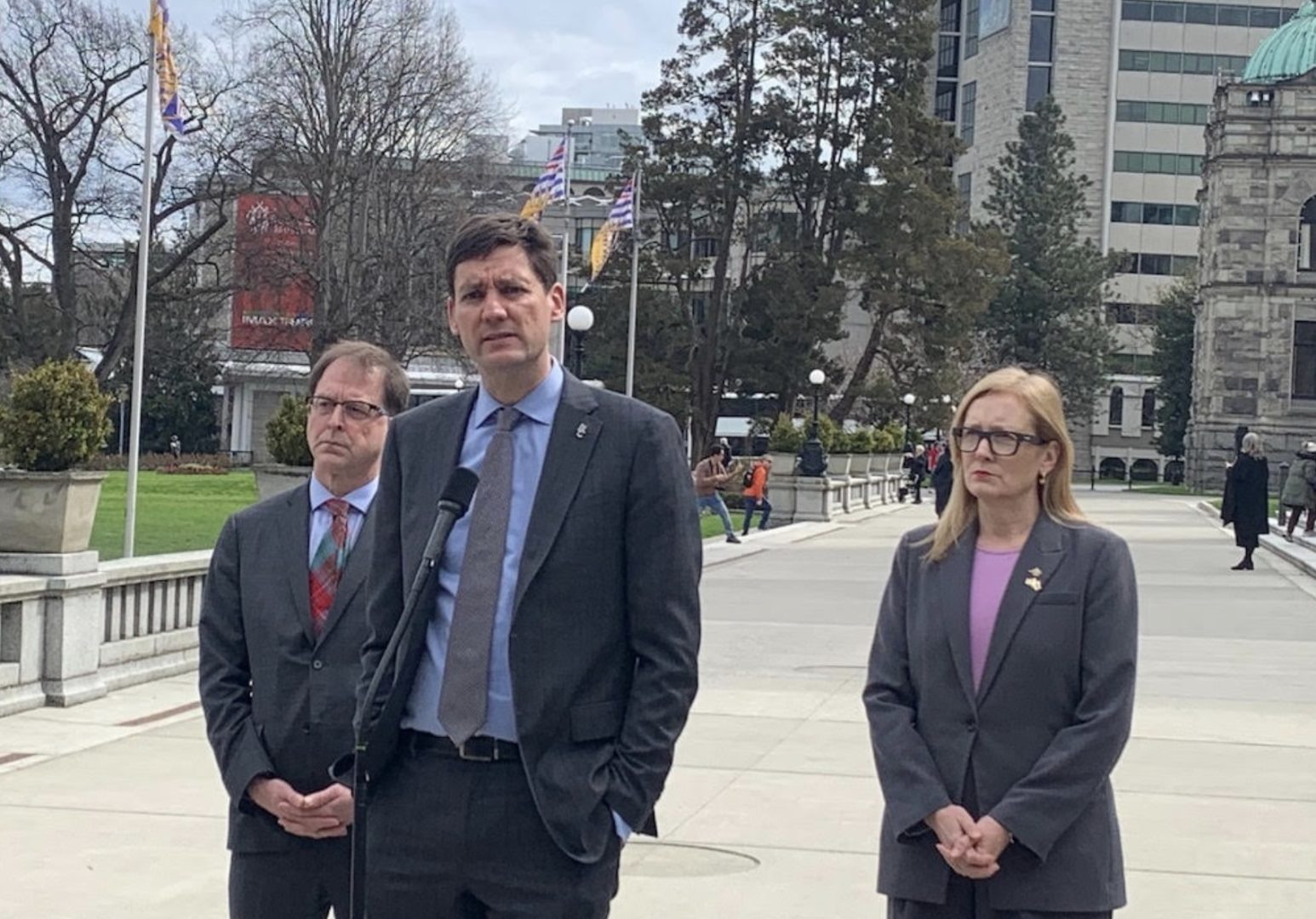
The day the NDP was pushing through a late-night session to axe its pioneering carbon tax, Dix told Northern Beat in an interview he’s prepared to make a similar reversal on B.C.’s emissions cap if a Conservative government forms, or if Carney gets a mandate and switches his position again to resolve tensions with Western Canada.
“Our plan is what we said, which is to work with the federal government and we’re going to do that,” Dix said March 31.
“Our plan is… to work with the federal government.”
Adrian Dix
Since the B.C. NDP formed government in 2017, three LNG projects are under construction, Dix. noted. They are the nearly-completed LNG Canada at Kitimat, a nearby floating compression plant called Cedar co-owned by the Haisla Nation and supplied by the Coastal GasLink pipeline, and Woodfibre LNG at Squamish that uses an existing gas line.
“And just for the record, that’s three projects to none by the previous government,” Dix said. “That’s $36 billion investment to none. They didn’t even get a field goal at the end of the game.”
Dix eases net-zero emissions policy
Dix was adamant not to speak about whether LNG Canada will proceed with phase two, but he has made a quiet move to open the door for it. In a letter dated March 21 to B.C.’s Environmental Assessment Office, Dix amended the province’s strict rule that LNG facilities would have to be “net zero” by 2030.
The letter tacitly admits that B.C. Hydro doesn’t have the electricity supply to run a facility such as LNG Canada phase two. Now projects must be “net zero ready,” which means net zero emissions by 2030 “…unless it is not reasonably possible, due to circumstances beyond the control of the proponent, for the project to be served by grid electricity by 2030….”
That change means LNG Canada could proceed with gas-fired electricity to run the massive cooling and compression machinery that makes natural gas into a liquid for shipping.
How much natural gas does B.C. have?
A lot.
Finding gas is easy, permitting it is not
Larry Neufeld, the new B.C. Conservative MLA for Peace River South, brings significant experience to his role as Opposition critic for natural gas and LNG. A professional engineer, he operated a gas well remediation business before entering politics. He is against existing emissions caps for B.C.
“Essentially it would put a cap on production, and we’re very much in disagreement with that,” Neufeld said. “We have a world-class supply of natural gas in this province. Our proven reserves at this point are in excess of 300 years’ supply with the current rate of usage.”
“Our proven reserves at this point are in excess of 300 years’ supply.”
Larry Neufeld
B.C.’s main supply area currently is the Montney shale formation around Dawson Creek and Fort St. John and extending into Alberta. North of that is the Liard shale, and above that is the Horn River shale, both of which have had some exploration work.
“I was a reservoir engineer many years ago, and I can tell you for a fact that proven reserves are often-times a fraction of what the real number is,” Neufeld said. “So we have a 300-year supply. The real number could be 1,000 years. We haven’t looked offshore, we haven’t looked in a lot of different areas.”
Finding gas is not a problem. Getting permits to drill is, and that problem has increased sharply since a court decision finding that oil, gas and forestry development has repeatedly violated Treaty 8, the 1899 treaty with the Blueberry River First Nations and others in the Peace region.
“I’ve received a lot of concern from both industry and landowners,” Neufeld said. “What has been happening with the significant challenges around receiving permits is that it’s really forced companies from the Crown land onto agricultural, private lands.”
Kitimat’s 20-year LNG journey
When Ellis Ross served on the Haisla Nation council two decades ago, his first goal for economic development was to use Kitimat’s strategic position on the North Pacific to build an LNG import facility. The shale gas boom soon made export the most viable option.
Elected Skeena MLA for two terms, Ross served briefly as minister of natural gas development before the Christy Clark government was replaced by an NDP-B.C. Green alliance in 2017. Now he’s running for the federal Conservatives in an effort to unseat NDP MP Taylor Bachrach in Skeena-Bulkley Valley.
Talk of an emissions cap reminds him of the years he and his community spent looking into the possibility of processing LNG using electric drivers instead of gas-fired power. A Chevron-led proposal at Prince Rupert, which later gave way to the Shell-led LNG Canada plant at Kitimat, looked at that option two decades ago.
“Everybody wanted [electric drives]… but there’s not enough electricity in B.C.”
Ellis Ross
“Everybody wanted it, not just LNG Canada but Chevron, to have electric drives,” Ross said in an interview from Kitimat on Apr. 1.
“And that’s when we found out, no, there’s not enough electricity in B.C. The infrastructure’s not there. And the dependability is what got us. We didn’t want any plant of that size to have a power outage.”
He said people were gathered on the beach, prepared to wait until 1 a.m. to glimpse the running lights of an LNG tanker from Australia arriving with the first test load for the LNG Canada facility.
“People in Kitimat and along the pipeline, they just want to see this get going after all this work and all the opposition,” Ross said.
“Now we’re talking about the strength of Canada. We’re talking about Trump and trade wars and how weakened we’ve become. If you’re going to get back on the road to being a stronger country, you’ve got to look at all the sectors, including LNG and forestry and mining and diversifying trade.”