

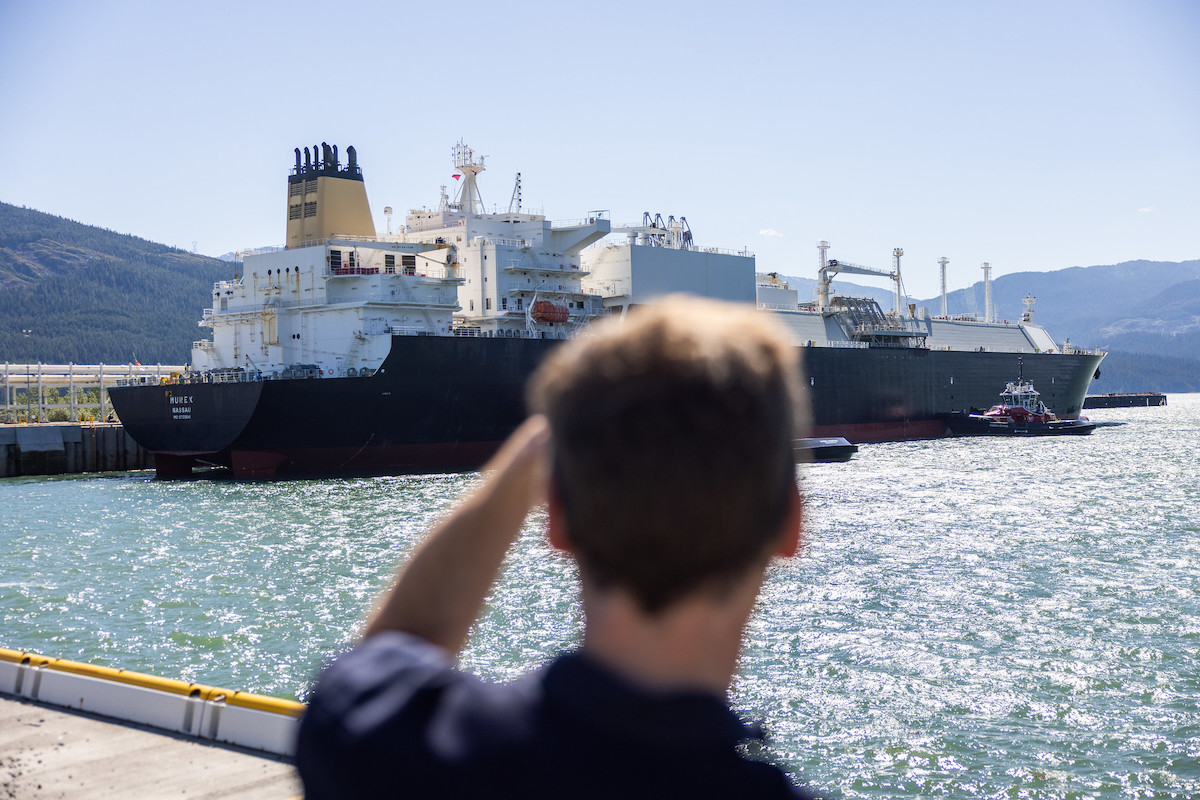
The Shell-led consortium behind LNG Canada expects to start work on phase two of its Kitimat gas-export facilities in 2027, with TC Energy upgrading the Coastal GasLink pipeline system across northern B.C. to double its capacity.
LNG Canada announced todayit will proceed with the expansion project, to increase export capacity from 14 million to 28 million tonnes per year. The existing pipeline will be upgraded with five more compressor stations to handle the volume, and Shell expects the phase two expansion and the pipeline increase to be in operation by the early 2030s.
As with the first two trains, LNG Canada’s next two compression and refrigeration units are to be powered by burning natural gas, a concession granted by BC Energy Minister Adrian Dix in early 2025. Dix told Northern Beat at that time his greenhouse gas emissions mandate was to work with the federal government, and new Prime Minister Mark Carney has since lifted a proposed emissions cap on oil and gas production to enable both to expand.
The B.C. and federal governments have pitched in to twin BC Hydro’s existing North Coast transmission line from the Peace River dams to Prince Rupert, with a northern extension to enable electric processing of LNG at a proposed floating Ksi Lisims plant on Nisga’a territory north of Prince Rupert.
A smaller floating plant, Cedar LNG, is also under construction at Kitimat. Majority owned by the Haisla Nation, Cedar LNG is to be supplied by Coastal GasLink as well, through a TC Energy connector pipe and compressor station.
Ksi Lisims requires completion of the pipeline formerly approved for a route to Prince Rupert, where PETRONAS first planned and then cancelled a large-scale LNG facility amid salmon habitat issues. Malaysia-based PETRONAS is now a 25 per cent partner in LNG Canada, with Shell Canada holding 40 per cent, PetroChina and Japan’s Mitsubishi Corp. owning 15 per cent each and Korea Gas five per cent.
Political credit-taking continues
Word had spread of the long-awaited LNG Canada phase two financial approval, with Carney squeezing a Vancouver visit into his intensive travel schedule on Tuesday.
His office highlighted the project’s “historic equity opportunities” through a company representing the Gitga’at, Gitxaala, Haisla, Kitselas and Kitsumkalum nations. The agreement gives the five groups the option to invest up to $1 billion to own the phase two LNG storage tank.
“This sale-leaseback structure ensures long-term revenue streams for local communities,” Carney’s office said in a statement.
“Thanks to LNG Canada’s decision today, TC Energy is moving forward with its own multi-billion-dollar phase two of the Coastal GasLink pipeline, and that means yes, doubling capacity, creating an additional 2000 jobs, maximizing the value of the Western Canadian Sedimentary basin, one of the world’s most prolific natural gas [formations],” Carney said.
B.C. Conservative leader Lorne Doerkson announced Monday that his party was committed to doubling LNG production by 2032 and tripling it by 2035 in what he called his party’s B.C. Energy Superpower Plan.
NDP leader David Eby quickly responded Monday that the projects currently underway or awaiting final investment decisions would already more than triple existing production by 2035. Those include LNG Canada phase two, plus Cedar LNG and Woodfibre LNG near Squamish, all of which are under construction. Add to that Ksi Lisims LNG and Tilbury Island phase two near Delta, which received its B.C. environmental assessment certificate the day before Eby called a snap election for Oct. 24.
FortisBC’s Tilbury started life as a ship-loading dock for LNG-powered vessels, including BC Ferries. The expansion plan would enable smaller-scale export sales.
NDP and BC Liberal politicians argued for years over who got the LNG industry started in B.C. When asked yesterday if the BC NDP or the Christy Clark government should get credit for kicking off LNG in B.C., David Eby danced around the question, eventually saying only that the BC Liberals had “let ‘er rip” environmental standards and “they didn’t deliver a single facility, not one.”
Earlier in the day, Doerkson had recounted that 20 LNG projects had been proposed since the mid-2000s and the BC Liberal government of the day had anticipated three to five would be up and running by 2020, yet only LNG Canada was operating.
The process of building the LNG industry goes back decades. Ellis Ross was the elected chief councillor of the Haisla Nation who first worked toward transforming Kitimat into the host of an LNG import facility in the late 1990s, before the shale gas revolution changed the energy landscape.
In February 2013, Ross joined former Conservative Natural Resources minister Joe Oliver at an LNG conference in Vancouver, where Oliver announced the largest export permit in Canadian history was being issued for LNG Canada.
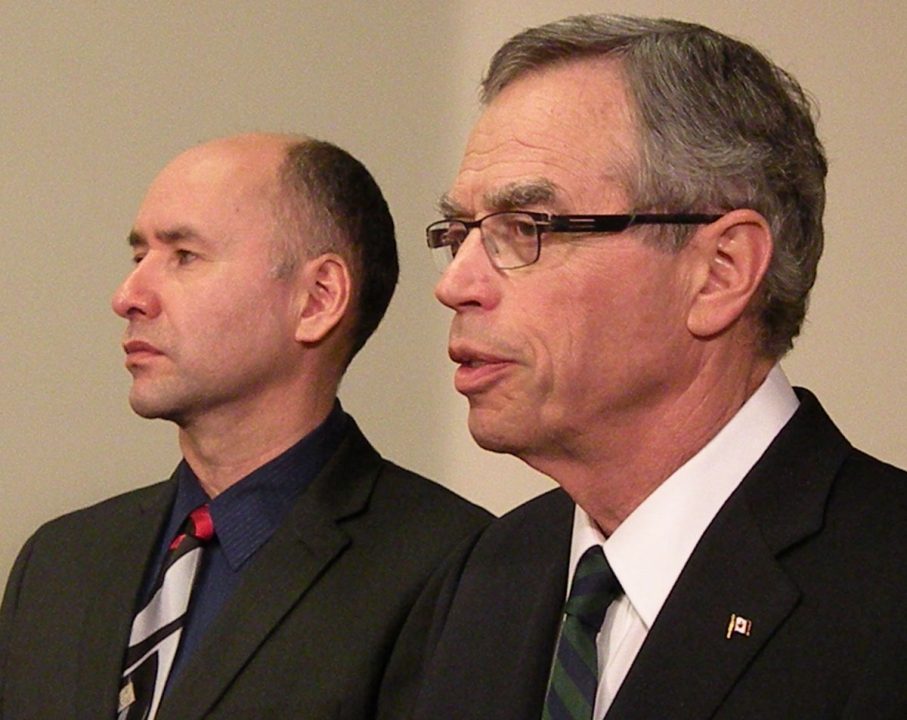
In February 2013, Ross joined former Conservative Natural Resources minister Joe Oliver at an LNG conference in Vancouver, where Oliver announced the largest export permit in Canadian history was being issued for LNG Canada.
After stints as Skeena MLA and briefly B.C.’s minister for natural gas development, Ross joined the Conservatives again with the 2025 federal election, this time as MP for the region.
Posting on social media today, Ross said the announcement was bitter sweet.
“In 2004, when my Indian Act Band Council started reviewing LNG Exports, we formed the narrative on why it was a game-changer for First Nations, BC, Canada and the world.
“We had very little support except for other First Nation leaders along the pipeline route,” Ross wrote.
“The re-announcement today affirmed that what we had been saying all along was right on the money and the BC NDP and Federal government were wrong.”
Asia demand high, but Europe farther away
The opening of LNG Canada phase one marked the first time B.C. and Canada were able to export natural gas anywhere other than the United States. As trade disputes continue with President Donald Trump’s administration, the latest LNG project shows the rising global demand for Canada’s LNG, said Gabriel Giguère, senior policy analyst at the Montreal Economic Institute.
Giguère noted that in recent years, not only Japan and South Korea have looked for B.C. gas, but interest has been expressed by Germany and Poland as well. In an interview, he qualified the situation for Europe.
“While LNG from the West Coast can compete to supply Europe thanks to swap deals, it’s certain that natural gas pipeline projects such as Kino Aski LNG, on the East Coast, would make us more competitive in directly reaching European markets,” Giguère told Northern Beat. “In essence, West Coast pipelines help our European allies by increasing overall global supply, but East Coast ones would help reach those markets directly. After all, shipping from Eastern Canada to the main European terminals is faster than it is from either the U.S. or Qatar, reducing costs.”
The volatile Middle East conflict affecting the Strait of Hormuz, with Qatar among the world’s largest LNG suppliers, is disrupting gas markets as well as oil and liquid fuels.
‘Part of the problem we’re seeing in the Middle East is that the conflict has shaken supply chains, leading to less pre-visibility in deliveries and ultimately higher prices,” Giguère added. “Utilities are looking for more stable and reliable supply, and that’s what Canada can offer.”