

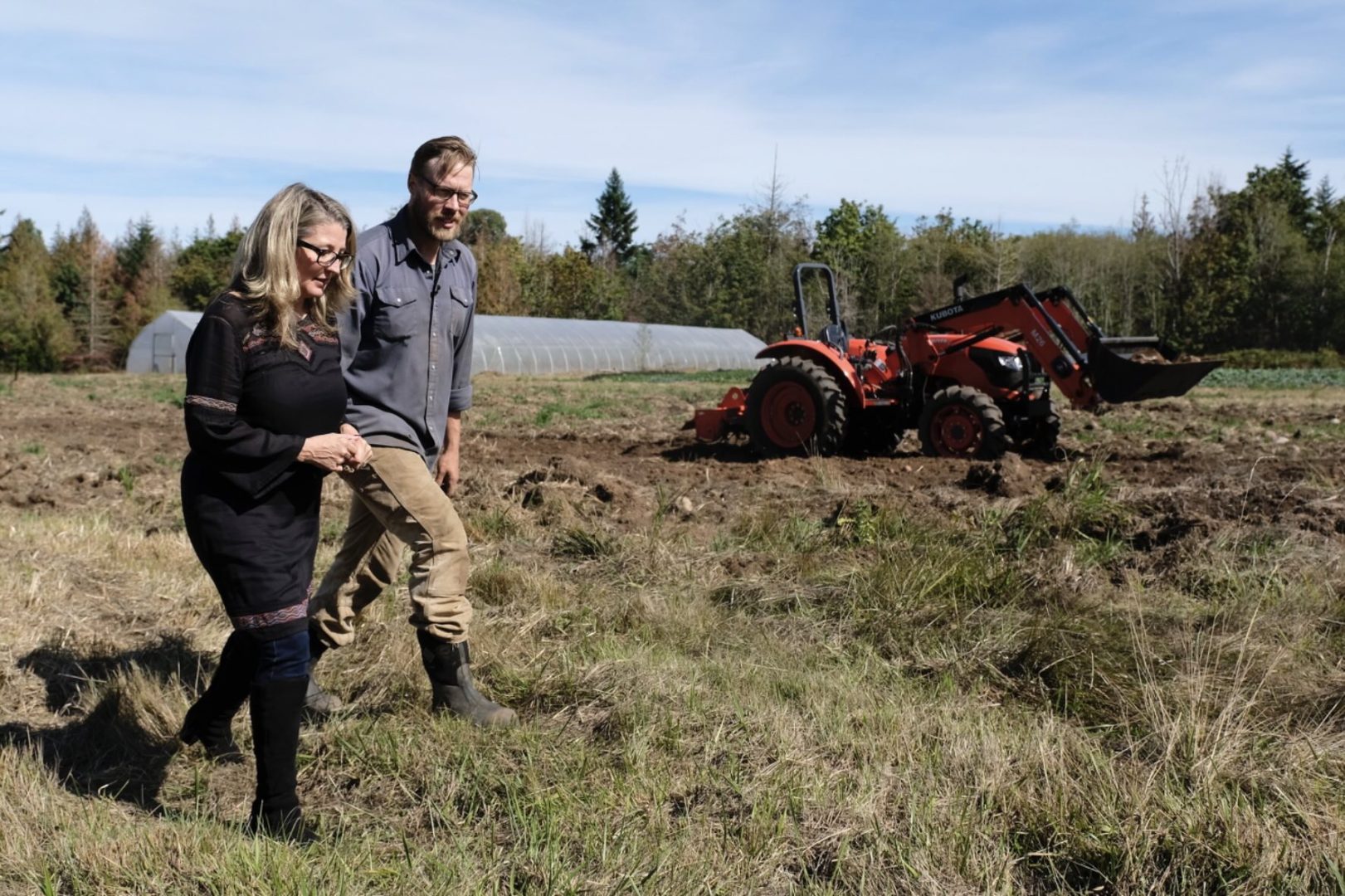
The B.C. government is opening the door for more food production on agricultural land, with new policies that business and agriculture advocates say are actually a fair compromise between boosting food security and protecting farmland.
Agriculture Minister Lana Popham announced the changes in response to a year-long push by the business community to scrap a controversial policy called the 50-50 rule, which limits food production on farm land to at least 50 per cent product from that specific farm.
“There are checks and balances in this proposal,” Popham said in an interview.
“It took awhile to get there, as you know. But it’s a complicated, complicated situation. The implications of not doing it correctly are, in my view, huge.”
The government has opened feedback on the changes until Sept. 3.
Critics had argued the 50-50 rule restricted farmers from making even simple things like multi-berry jam and mixed salad using ingredients from other farms, and locked the province out of new federal funding available for food security hubs in response to U.S. tariffs.
Premier David Eby had expressed interest in more food manufacturing last year, and Popham has tried to find what she called “the middle ground” between processing and protecting farm land.
Changes are ‘reasonable compromise,’ says business leader
Ultimately, the minister landed in the right spot, said Bridgitte Anderson, CEO of the Greater Vancouver Board of Trade
“This is a reasonable compromise,” said Anderson. “It will unlock investment, and increase food security.”
“It will unlock investment, and increase food security.”
Bridgitte Anderson
The Abbotsford Chamber of Commerce, where three-quarters of the land base is in the Agricultural Land Reserve, agreed.
“We’re supportive of this,” said CEO Alex Mitchell. “There needed to be some form of modernization and a recognition food processing and agriculture go together, and allowing for food processing to occur in our region is pretty key to food security and our overall economic competitiveness.
“This is a happy meeting in the middle and we’re appreciative the province has recognized it is really important.”
Local product requirement will drop from 50 to five per cent
The change would reduce the 50-50 requirement to five per cent local product from any farm in B.C.—but only on the least viable farm land in the Agricultural Land Reserve, designated as class five, six or seven soil.
Some processing plants could also be built on more fertile ALR farmland, known as class four, but only if it is already serviced by a road, electricity and water services when the changes come into effect.
The soil classification rules would exclude 90 per cent of ALR farmland in Metro Vancouver and the Fraser Valley. But it would also leave between 500 -1,000 hectares designated for potential food production plants, the government estimates.
“That’s significant,” said Anderson. “That’s the signal to investors they are welcome to come invest and set up and increase their food processing here. That is a really good sign.”
The government also intends to place a total cap of 0.25 per cent of the 2.1 million hectares of privately-owned ALR land for food processing. And the 50-50 rule would remain in place for the most prime ALR land, from class one through four.
Production change aligns with federal funding opportunity
“I’m going to give praise where praise is due to both minister Popham and the premier, this is a reasonable compromise,” said Lenore Newman, director of the Food and Agriculture Institute at the University of the Fraser Valley, who had advocated for changes to the 50-50 rule.
“It aligns with federal food security goals at a critical time. As long as this is rolled out for September, we’ll be in good stead to catch some of the federal funding to build things that look a lot like the Ontario Food Terminal.”
Popham said she’s already talked to the federal government about a B.C. version of the Ontario Food Terminal, which is a kind of central hub connecting farmers, buyers, sellers and processors, under the new changes.
“I feel like we’re trying to meet the moment here, and it’s great timing,” Popham said.
“I feel like we’re trying to meet the moment here.”
Lana Popham
The federal government has billions of dollars on the table as part of its new national food security strategy, launched this spring in a bid to boost domestic processing in response to American trade aggression and global supply chain disruptions.
There’s $350 million to help build food manufacturing and packaging, plus $1 billion over 10 years for a food link fund to expand food terminals.
Newman said companies like McCain Foods have dismissed investing in B.C. because of the restrictive processing rules. That’s resulted in a windfall for provinces like Alberta, which secured a $600 million investment from McCain in 2023 that spurred potato farming in the province, she said.
“If you build processors, you get farmers,” said Newman.
“Academic studies demonstrate if you have more food processing, food prices go down. To be honest, I think everyone is in favour of that right now.”
Increase in processing may boost food production, says expert
The change will boost production plants in Metro Vancouver and the Fraser Valley, close to rail, ports, highways, an established workforce and public transit, said Newman. But it will also bolster production in the Okanagan, and perhaps as far as the Peace Region where grain could be processed to add value, she added.
“The thing I’m really looking for is then does [additional food processing plants] drive farmland,” said Newman.
“If you build processors, you get farmers.”
Lenore Newman
“Because our biggest crisis in B.C. in the framing sector is plunging use of the ALR. And people are using it more and more as a place to build a nice estate home and not a place to farm. We’re seeing farmers leave. If we can reverse that number, then it’s a success.”
The Opposition BC Conservative caucus would not make agriculture critic Ian Paton available for an interview to respond to the government policy change, despite repeated requests. Paton, a farmer with decades of experience, had been outspoken on the 50-50 rule prior to the arrival of new leader Kerry-Lynne Findlay and media restrictions imposed upon MLAs by her senior staff.