

“Repeal. No more fooling around. They were wrong to bring it in.“
—Jason Kenney
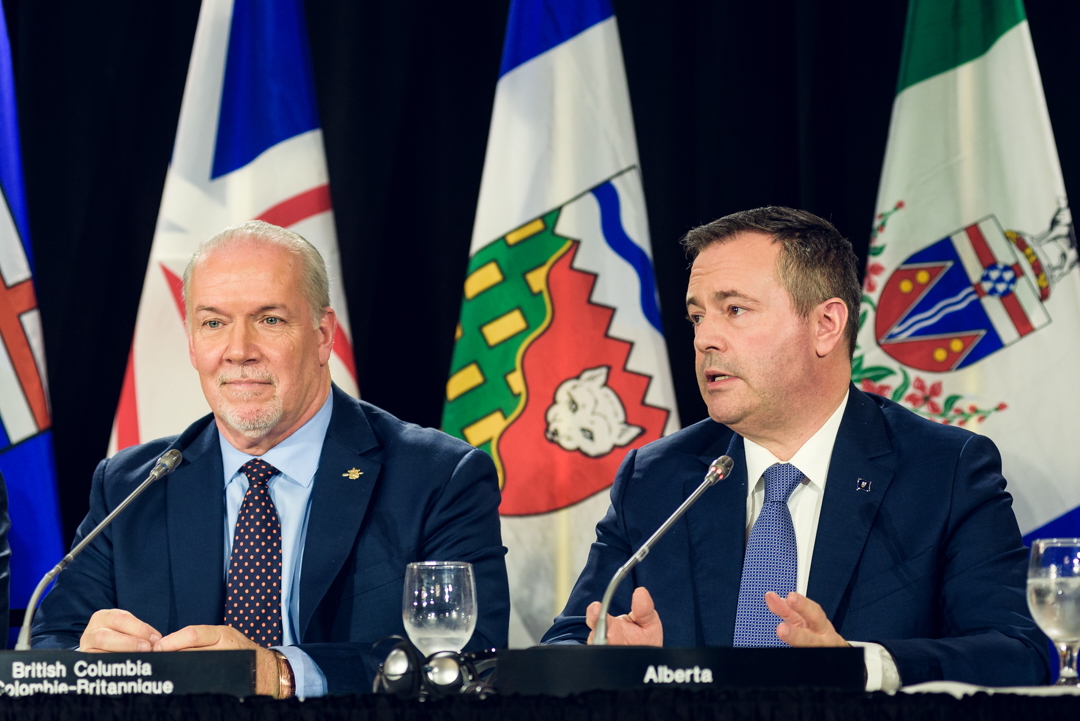
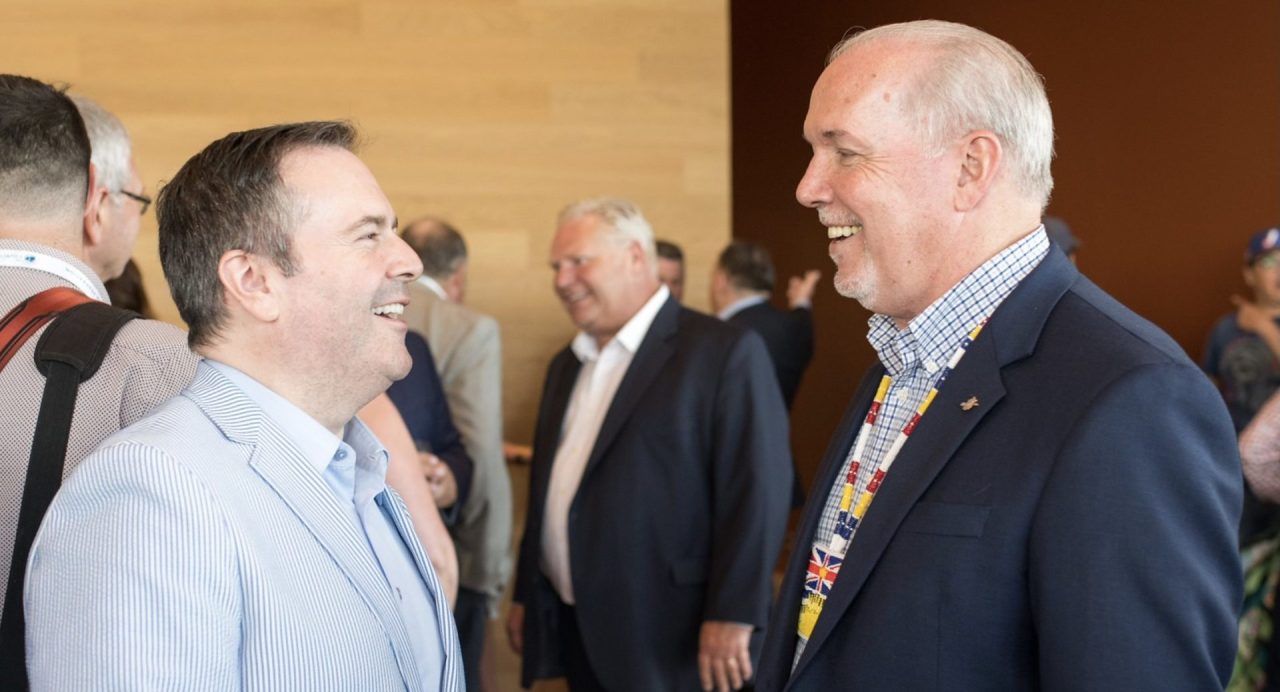
When John Horgan and Jason Kenney were premiers in neighbouring provinces, they developed a good working relationship, a friendship even, according to Kenney.
“Now, John and I disagreed on a bunch of things, of course, but… I found him to be an honest dealer who worked in good faith,” Kenney told a crowd of federal and provincial Conservatives in Victoria this week.
“When we first met, [Horgan] said to me, ‘Jason, you need to understand something.’
“[Horgan] said, ‘I come from the old union, pro-jobs, pro-growth, pro-resource wing of the NDP. But I’m managing,’ he said at the time, ‘two Green parties.’
“He said, ‘I’ve got the Green Party that I’m in a coalition agreement with, and then I’ve got a Green Party within my own caucus.’
“He said, ‘I’m not part of that,’ and he called them the ‘mud hut wing.’
“‘I’m not a mud hut New Democrat,’ he said to me, ‘I actually believe in growth.’”
According to Kenney, Horgan essentially told him B.C. had to challenge the Trans Mountain pipeline expansion for political reasons. But when the Supreme Court ruled the federal government had constitutional authority over coastal infrastructure and provincial pipelines, Kenney said Horgan promised the B.C. government would not stand in the way, and personally committed to ensuring there would be no delays.
“‘It’s going to be good for Canada,’ he said, ‘but you need to beware of the mud hut wing in my own party,’” Kenney recalled.
“And that’s what’s happened.
“The mud hut wing took over.”
‘Lawfare’ legal tactics attack resource industries
“Your premier is not from the pro-jobs, common sense, old-school union wings of the NDP that in this province was rooted in the lumber workers unions and the forestry workers unions,” Kenney told the crowded room.
“This guy comes from the hard, urban, legal left of the NDP. He came out here from Ontario, and he has said publicly that his pre-political vocation was ‘suing governments.’ And he did that in indigenous law. He did it in environmental law. He did it as head of the BC Civil Liberties Association – which I’m old enough to remember, when it was a fairly mainstream organization [before] he cranked it to the hard left.”
For 20 years, Eby and other like-minded people, have used “lawfare” – legal tactics to attack industry, to attack resource industries, in particular – because they are ideologically hostile to democratic capitalism, Kenney said.
“The mud hut wing took over.”
Jason Kenney
“These urban, green, left environmental lawyers have engaged in what Ellis Ross calls ‘eco colonialism,’” Kenney said. Ellis Ross, is a former Haisla chief councillor and BC Liberal MLA, who now represents Skeena as a Conservative Member of Parliament.
“Eco colonialism means people of European descent like David Eby trying to appropriate the moral authority of Indigenous people to advance their rigid, ideological, green-left agenda.”
The effect of this lawfare, he said is to lock communities in poverty, Kenney said.
“Everything that has gone wrong in British Columbia in recent years can be attributed to that ideology.”
BC’s economic policy ‘a total catastrophe,’ says Kenney
Kenney called it “absurd” to think that legalizing hard drugs will de-stigmatize people languishing on the streets or that handing out ‘safe supply’ addictive drugs will help people with addictions.
B.C.’s fiscal policy is “a total catastrophe” that is “driving this province’s finances off a cliff,” he said.
On Alberta’s proposed northern oil pipeline to the west coast, Kenney said, maybe it will get built, maybe it won’t. If it does advance, it will be a hard, long, expensive, rigorous process that will involve consultations with B.C, Indigenous communities and regulators.
Kenney accused B.C. of blocking major projects, citing efforts to stop the Trans Mountain expansion, which he said has added $20 billion of value to the Canadian economy.
“And they never admitted it up front, but [Eby] was standing in the way of the large-scale expansion of liquefied natural gas with ridiculous policies about tying it to non-existent hydro electricity in the future,” said Kenney.
“I mean this is a guy whose idea of economic growth is basically more fair-trade coffee co ops in the East Van and Kitsilano, and more grants to leftwing special interest groups. “That’s not how you build a big modern economy.”
Consequential court decisions are racking up
Instead, Kenney said Eby and others have used the legal system to deliberately create economic uncertainty around indigenous issues. And in the last month, “the chickens have come home to roost.”
The Gitxaala v British Columbia BC Court of Appeal decision earlier this month stated the 2019 Declaration on the Rights of Indigenous Peoples Act (DRIPA) was “justiciable,” as in, it can be wielded as law in court. The ruling also stated that B.C. had broken its own law when the Mineral Tenure process did not conform to DRIPA or the Interpretation Act of 2021.
Both DRIPA and the Interpretation Act stipulate all B.C. laws must conform to the United Nations Declaration on the Rights of Indigenous Peoples (UNDRIP). Among the contentious provisions is section 7 (1) (b), consent-based decision-making, which requires the need to obtain consent of Indigenous bodies prior to a decision by the Crown – in other words, a veto – even on legally unproven, but claimed territory.
This followed the Cowichan Tribes v. Canada BC Supreme Court decision in August which found Aboriginal title on about 800 acres of private, industrial and public land in Richmond, B.C.
The Cowichan decision was the first time a court recognized Aboriginal title co-exists with private property title. Although the Eby government had already essentially done the same thing a year-and-a-half earlier in the Haida land title agreement, when it recognized Aboriginal title over private property on the nation’s 10,000 square kilometres of claimed territory.
Both court rulings have triggered calls on the government from the Opposition, Independent MLAs, the business sector, the legal community, and citizens to repeal DRIPA. B.C.’s premier in particular has faced more heat for the situation since he was the attorney general who introduced both DRIPA and the Interpretation Act under the late John Horgan’s NDP government.
Eby blames ‘overreaching’ justice system
In response, the premier accused the courts of jeopardizing the B.C. economy.
“To face such dramatic, overreaching and unhelpful court decisions as we have seen over the last couple of months, is deeply troubling,” Eby recently told a business audience on Dec. 10.
Dismissing the possibility of a repeal, Eby said his government will consult with Indigenous leaders and draft amendments to DRIPA and the Interpretation Act, but does not have plans to reconvene the legislature early. The 2026 session is scheduled to begin Feb. 12.
“To face such dramatic, overreaching and unhelpful court decisions… is deeply troubling.”
David Eby
And while he has promised to “go to the wall” for private property rights, the B.C. government so far has yet to even file a stay of proceedings on the Cowichan decision. An offer to provide loan guarantees on mortgages in Richmond lacked details and would do nothing to fortify title rights for private landowners.
Instead, the Eby government has continued to sign joint and consent-based decision-making land use agreements with First Nations in the name of DRIPA.
“The problem is, once those agreements are signed, I don’t know how they can be abrogated, because I’m pretty sure the Haida would go to court and any Crown abrogation of the agreement would be hard to sustain under judicial review,” said Kenney.
“So that cat may be out of the bag,” he said.
Meanwhile, people’s home values and the entire future of the provincial economy are in jeopardy, and this province may be paralyzed economically if it doesn’t restore some balance, he said.
“The situation is deteriorating rapidly, to the point where even Eby himself, God forbid, criticized the courts the other day. That is how much, how far gone this is.
“But he’s the arsonist who’s now calling the fire department.”
‘No more fooling around’
The BC NDP really have only one option, Kenney said in a brief interview this week.
“Repeal. No more fooling around. They were wrong to bring it in.
“There’s no half measures that will work here. Court said this is your legislation, unless there’s prior informed consent, it does not pass muster. So the only avenue, I think, is to repeal. And I mean that doesn’t solve the problem with the jurisprudence on the Richmond case, the Cowichan decision, but they do have statutory control over the UNDRIP problem.”
Kenney held out some hope the B.C. government will yet take action.
“I’ll give Mr. Eby some credit. He admitted they were wrong about the retail carbon tax. Reversed it. Admitted they were wrong about safe supply and decriminalization of hard drugs and repealed it. Although he is a, I think, a real doctrinaire left-wing ideologue, he has shown a willingness to change course when reality intrudes, and public opinion.”
If this tangled political and legal situation happened on his watch as premier, Kenney said “I would recall the legislature immediately, repeal the UNDRIP thing and develop a legal strategy to deal with the consequences of the Cowichan decision.”
When asked what he would say to the attorney general who drafted the bills, Kenney’s retort was swift.
“You’re fired.”
LISTEN to our podcast with Tom Isaac, Aboriginal law expert, who cuts through the noise on DRIPA, Aboriginal title, private property and more.