

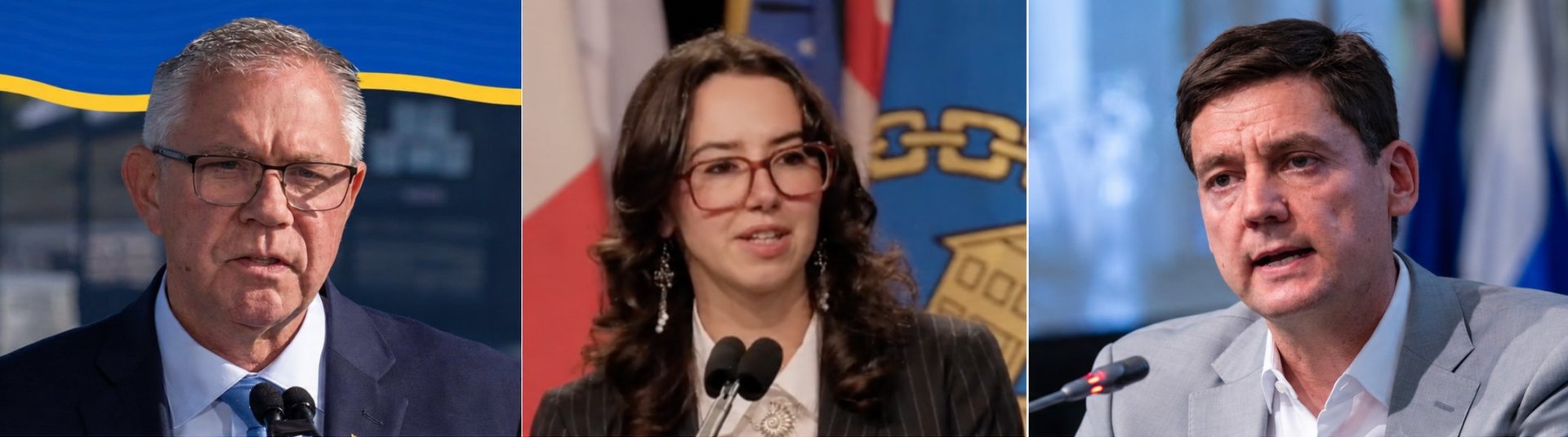
There’s nothing like an election to get the blood flowing and the political promises moving. Such is the case when it comes to small business in the province.
Several consequential promises have landed in the campaign so far.
BC NDP leader David Eby said his re-elected government would offer interest-free loans of up to $1 million to small and medium-sized businesses affected by the U.S. trade war and rising costs. The loans would be good for up to 72 months.
“These interest-free loans will provide the support that the small and medium-sized business leaders have come to us and said they need to be able to get through this period, and our commitment is that we will deliver that for them,” said Eby.
It’s long been a request from the business community to get some sort of government backstop for the small businesses sitting precariously on the edge of the trade war. But it’s taken almost two years for the governing party to move on the issue, and only during a campaign.
BC NDP promise tax credit for youth hires
Similarly, business leaders like the Canadian Federation of Independent Business have been urging government to create incentives for business owners to hire youth. British Columbia and Saskatchewan are two of the only provinces without tax credits and wage subsidizing to make it easier to hire young people and get them experience in the workforce. It comes at a time of high youth unemployment, and concerns expressed by political leaders like Eby that temporary foreign workers are cheaper and easier for some businesses to hire than local youth.
Eby promised a $5,000 refundable tax credit for youth hires for small businesses on Wednesday.
“This money will help small businesses bring on employees, and will provide an opportunity for a young person to get that first job, to get into the job market, to get that experience,” he said.
It moves B.C. in line with Manitoba, and ahead of Ontario, in youth employment incentives, which the CFIB praised Wednesday.
Still, the election campaign has also frozen some critical business policies mid-stream.
Election delays long-awaited food production changes
The multi-year campaign to get B.C. to open up more food production on protected Agricultural Land Reserve property was on the verge of becoming a reality prior to the early writ drop in September. The government was just wrapping up extended consultation, before Eby plunged voters into an early election.
Now, new federal funding has opened up for food processors at a time when the B.C. government is caught mid-stream in changes. Eby tried to brush aside the impact.
“We had the farmers ask for a little bit more time to do engagement on that with their members and provide feedback to us as government,” he said. “That will conclude this month, and then we’ll be in a position to make any changes.”
If he wins re-election, that is.
In the meantime, the farming sector is stuck with prohibitive rules at a time when Ottawa is funnelling critical cash out the door.
BC Conservatives will cut PST on new investments in businesses
On the BC Conservative side, leader Lorne Doerkson offered up a long-requested change to drop the Provincial Sales Tax on capital inputs for businesses.
The PST is an archaic tax, embedding itself again and again on machinery, equipment and other items businesses buy on the road to making a product or service. Since B.C. backed out of the Harmonized Sales Tax in 2013, the business community has been asking for the PST input exemption to improve competitiveness.
“Right now, when a local business buys the equipment its workers need, the seven per cent PST acts as a direct penalty on that growth,” said Doerkson.
“We are eliminating the PST on more business investments in machinery, tools, and software for a three-year period. This will absolutely give B.C. businesses a very massive incentive to invest in their businesses and help us supercharge the B.C. economy. That is our plan. It is to supercharge our economy.”
The Conservatives did not immediately disclose the cost of the PST input holiday.
The NDP said their interest-free loan program is worth $500 million — most of which, presumably, would be paid back by the businesses over three years.
The two parties have sparred over how each other’s promises would be funded, with both pledging to release fully-costed platforms later in the campaign.
Greens unveil ‘green industrial strategy’
The BC Greens, mostly free of having to cost their platform, but also fuelled by a proposed wealth tax on people with more than $50 million that it says could generate more than $22 billion, have a different set of promises on business.
Leader Emily Lowan has called for a wholesale shift in government, to use its purchasing power to support local businesses and build regional economies. It’s part of an “economic vision” for the province the Greens released Wednesday that promised to “develop a green industrial strategy that coordinates electricity, infrastructure, skills, financing, research and public procurement around areas where B.C. has the ingredients to build lasting industries and good jobs.”
The Greens have virtually no chance of being able to directly implement their ideas in a government. But they could, once again, hold the balance of power in a deadlocked legislature if the current trajectory of a close race continues. Which makes their platform worth reading in the business community.
In the meantime, at only the half way point of the election, expect more promises to start flying as more voters turn their mind to advanced voting that begins Oct. 16.