

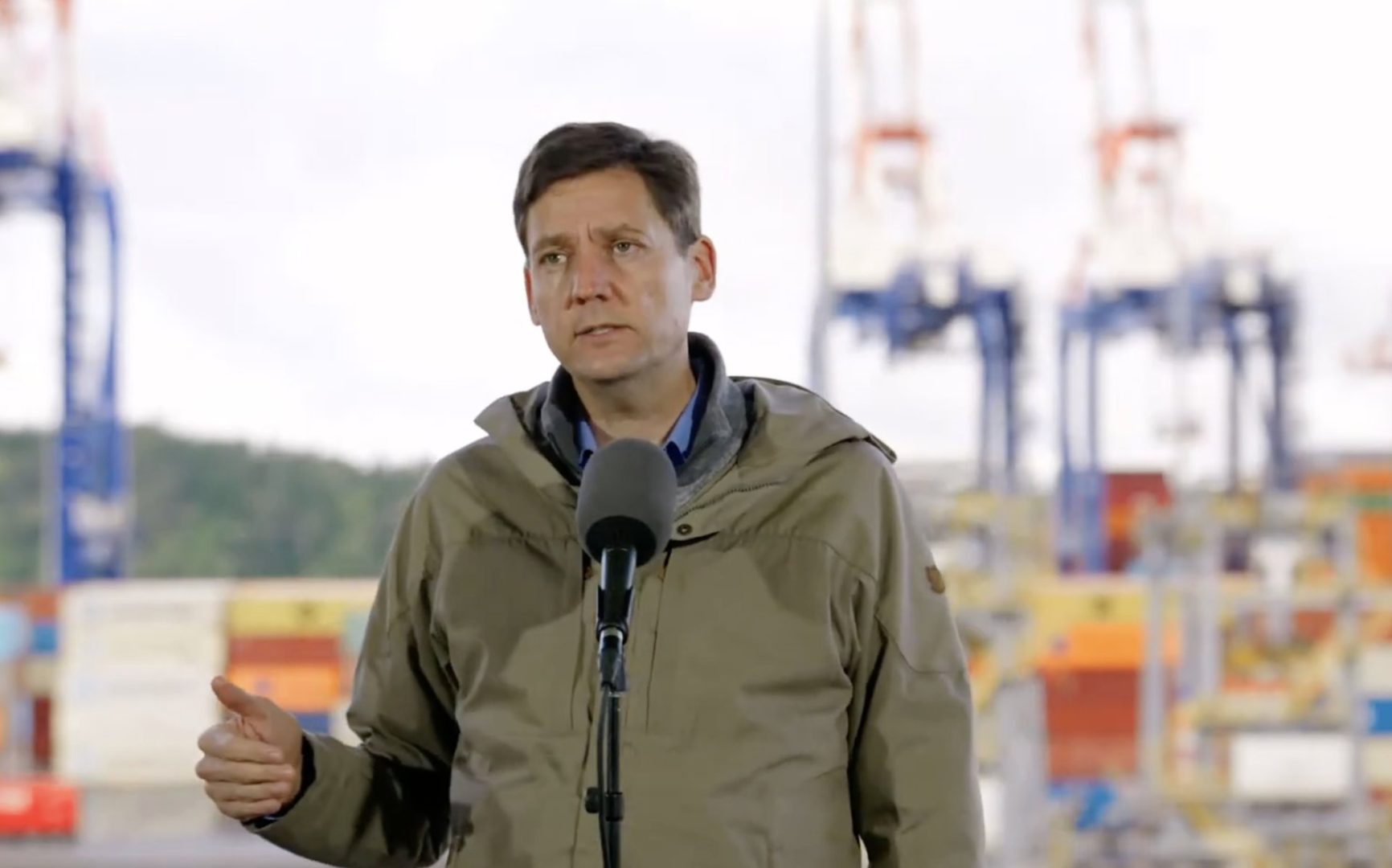
To justify a costly, disruptive and unnecessary snap election call, David Eby is telling British Columbia voters his government needs the increased stability of another mandate to deal with the chaos of the opposition and an “existential threat” from south of the border.
It’s a dubious argument given Eby already has a majority government and two years left in his mandate. There is nothing stopping the BC NDP from dealing with this so-called existential threat right now. If anything, calling a snap election has caused more instability, in both provincial and municipal governance. And the NDP’s attempt to implement an United Nations declaration as the government gold standard in its dealings across various sectors—particularly, natural resources—has created chaos in B.C. like never before.
I will leave it to British Columbians to assess whether the province’s deteriorating fiscal situation—from a nearly $6-billion surplus to a $13.8-billion deficit during Eby’s four years at the helm—is the stability they are after. The Eby government has not revealed how much its many “reconciliation agreements” and other secretly negotiated arrangements on the Aboriginal file have added to that red line. But this much we all know, on Eby’s watch, the province now bears the ignoble burden of having the highest debt and deficit in B.C.’s history.
Sticking to my lane, I can say without hesitation the NDP decision to pursue a United Nations declaration as the legal model for Aboriginal/Crown reconciliation in B.C., has created massive unknown expense, and unmitigated uncertainty and instability on the land base.
The Declaration on the Rights of Indigenous Peoples Act (DRIPA), which channels the UN Declaration on the Rights of Indigenous Peoples (UNDRIP) into British Columbia law, has been an expensive and disastrous failure of public policy at a time when the province has never been more broke.
Pledged by two NDP administrations as the road to certainty on land use, and land and resource investment, the ideological adoption of a non-binding United Nations resolution as the basis for reconciliation in B.C. has proved instead to be the vehicle for driving all three off a cliff.
UNDRIP is impossible to implement as law
The adoption of UNDRIP was driven by the Calls to Action of the Truth and Reconciliation Commission. Originally touted as a new reconciliation model that would supposedly conform with section 35 in the Canadian constitution, it has instead supplanted the Canadian constitutional recognition and affirmation of Aboriginal rights—which itself has evolved into a problem of almost equivalent proportions.
The late John Horgan’s government in B.C. rushed to embrace this impractical proposition on what appear to be purely ideological grounds, when it passed DRIPA in 2019. Purely ideological, because there is no way the law can be implemented.
All British Columbia laws simply cannot conform to UNDRIP, it is literally not possible. Not least because the UN declaration states that all territory claimed by Indigenous groups is “owned” by them. With almost all of the province claimed by the 204 First Nations, that ultimately leaves no private or public land remaining. Which appears to be the goal of the Eby government and its reconciliation advocates, otherwise known as the ‘land back’ movement, but that is for another column.
The UNDRIP reconciliation template also insists Indigenous consent must be obtained for any land use or development anywhere within their often vast claimed territories. Even new legislation must be co-developed and have Indigenous consent, despite the undemocratic nature of a publicly elected government “co-governing” with a self-appointed, special interest group.
In late 2025, the folly of passing DRIPA and adopting UNDRIP principles came to the fore when the BC Court of Appeal determined that UNDRIP had full legal force in this province. Meaning, all laws must conform to the declaration, immediately. Which even the premier admitted opens the province to “significant legal liabilities” since any law can now be challenged as not aligning with UNDRIP.
All due to the remarkably poor legislative drafting choices of the Horgan and Eby governments, particularly the latter. Eby was the attorney general who introduced the BC Interpretation Act in 2021 and helped ram it through the legislature after less than 20 minutes of debate.
As a result, a non-binding international document that is in many ways completely at odds with Canadian constitutional law, has become a legally enforceable law in British Columbia.
Legal chaos and uncertainty on the land base have inevitably followed.
True reconciliation also protects the public interest
When the current opposition party calls for the repeal of DRIPA and the consequent removal of UNDRIP, it is not for ideological reasons. It is a matter of fundamental consequence for the protection of the BC economy, private property title, the natural resources sector and the public interest as a whole.
It is also entirely necessary if we wish to put the province back on track to negotiate balanced and fair treaties and properly pursue a reconciliation model that can alleviate literally decades of uncertainty on the B.C. land base in a fair and honourable manner. But treaty mandates and the broader pursuit of reconciliation itself must also include the public good.
Because what we have now is chaos in decision-making on the landscape. And if that is what constitutes “stability” to an NDP government, no stronger argument can exist for a change of regimes and a new political direction in British Columbia on the reconciliation file.