

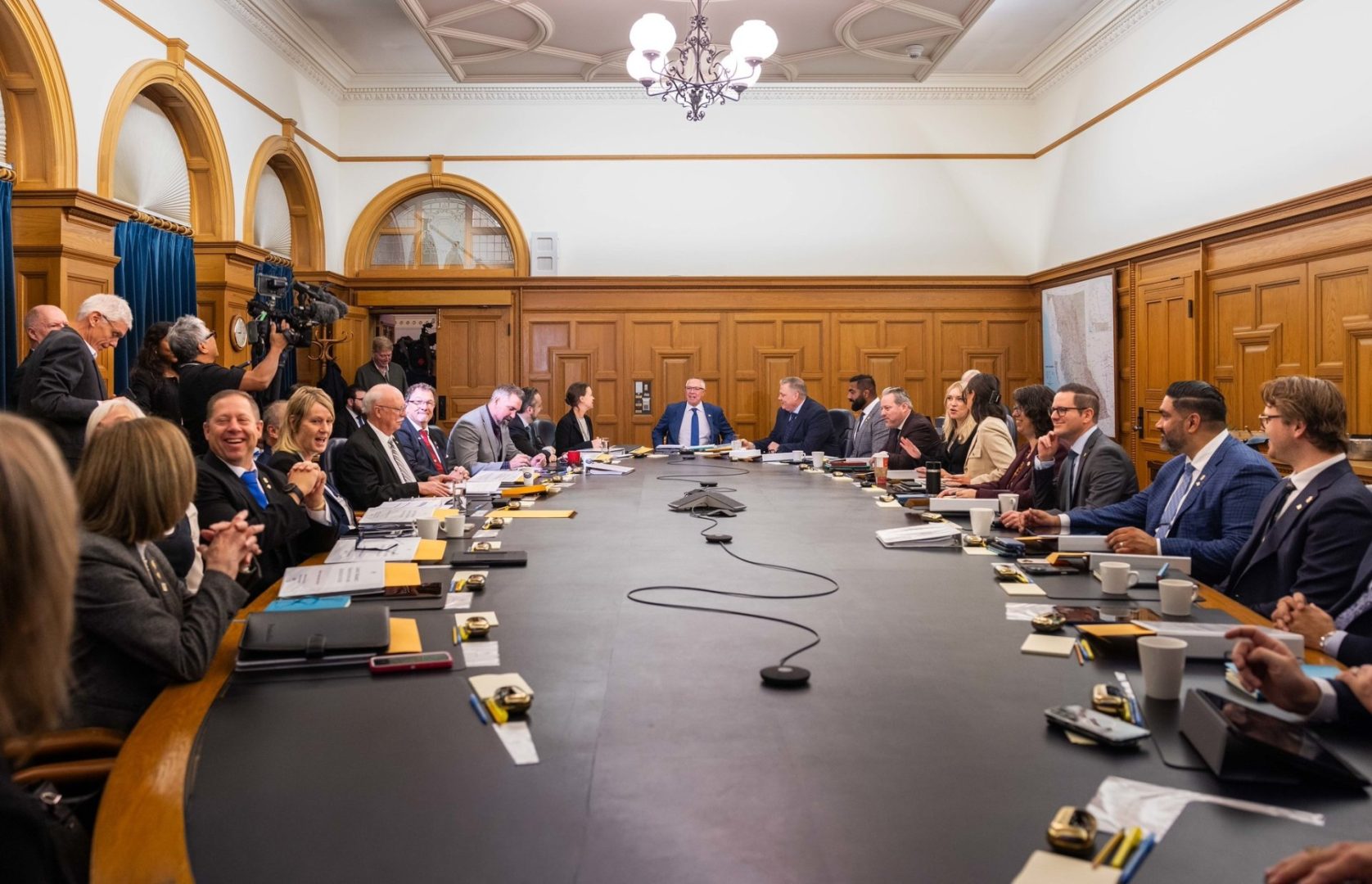
How many pages does it take to rewrite an entire government? BC Conservative Premier Lorne Doerkson has managed to do it in under 100, with a new set of mandate letters to cabinet ministers this week that marked a total overhaul of government policy.
Page after page, the new premier’s direction to ministers were sweeping.
Environment Minister A’a:liya Warbus was instructed to repeal the previous NDP government’s CleanBC policies. All of them. The entire provincial climate change program. Doerkson said it will save $700 million a year to scrap dozens of pollution reduction programs, policies and energy efficiency rebates.
“I’m just not certain what it’s achieving,” he said. “So we are going to move in a different direction.”
Consigned to the dustbin are B.C.’s GHG pollution reduction targets—though previous NDP minister Adrian Dix admitted government wasn’t going to hit those international benchmarks anyway.
Also eliminated are the zero-emission vehicle targets, which were once a nation-leading plan to phase out new gas-powered vehicles by 2035 but were watered down by the NDP as EV adoption slowed.
Doerkson called the cumulative effect of the environmental policies, which were once the cornerstone of the early John Horgan NDP government, “a burden to us all” that needed to be undone.
The new premier has quickly set about repealing a wide array of NDP policies in his mandate letters: the Declaration Act, SOGI, safe supply, overdose prevention sites, the Massey tunnel, autism funding reforms, tax increases, natural gas restrictions in new buildings, and more.
Much of it was in the Conservative election platform. But it was vague then. The mandate letters began to put flesh on the bone.
DRIPA, Crown litigation directives are out, property protections are in
Indigenous Relations was another area completely overhauled. Though the Conservatives kept the name of the ministry, Doerkson tasked minister Scott McInnis and Attorney General Caroline Elliott with wholesale change.
Not only will DRIPA be repealed, as the Conservatives promised in their campaign, but so well section 8.1 of the Interpretation Act brought in by David Eby that is at the centre of the Gitxaala court decision where DRIPA is used to overturn the Mineral Tenure Act.
Doerkson also instructed the two ministers to repeal the Crown litigation directives that forbid B.C. government lawyers from arguing that private property rights “extinguish” all previous titles, which is a live issue in the ongoing appeals of the Cowichan Nation’s landmark Aboriginal title victory in Richmond.
McInnis was ordered to develop an Aboriginal Title Transparency Act, to give the public information about what reconciliation agreements, involve what land, are being considered by government before they become binding. As well, Elliott was instructed to craft a Property Rights Defence Act “to uphold the validity of the Land Title Act on all fee-simple properties in B.C.,” according to her mandate letter.
“Reconciliation involves everybody in this province, and you know what you’re going to see from our government is a really concerted effort on transparency and engagement with the public on what our plan is moving forward,” said McInnis.
Gas-fired electricity plants are a go
Wholescale change was evident in almost every mandate letter.
For example, Agriculture Minister Ian Paton was instructed to “remap the ALR and reform the Agricultural Land Commission Act” using modern soil and mapping technologies — an enormous task that could reshape the scope and scale of protected farm land in the province.
That dovetails with orders to “encourage advanced food processing and manufacturing for domestic and export markets” and “modernize the 50/50 on-farm processing rule to increase year-round domestic food production and processing” that could lead to major changes on what is grown, built and processed on otherwise protected soil. Business leaders have been calling for the changes for years.
On energy, Doerkson has not only opened the door for more natural gas production in his mandate letters, but also instructed minister Larry Neufeld to “remove barriers to natural gas-fired electricity generation” as part of “ensuring all viable energy sources are considered” in powering the province.
That’s a major shift away from natural gas power plants, which the previous NDP government, and the Liberal government before that, had deemed to produce too much pollution to be worthwhile for electricity production in a province with abundant hydroelectric, wind and solar possibilities.
Now though, it’s back on the table.
AI data centres ‘worth considering,’ says premier
Potentially, gas plants could open B.C. up to allowing AI data centres to use natural gas power, to alleviate their draw on the electricity grid, like in Alberta. The previous NDP government had effectively banned them but forbidding the electricity draw necessary for construction.
“With respect to AI centres, I have had my own personal concerns around this, however it is certainly worth considering,” he said.
“There will be more to say on this as we share details in the coming weeks and months about our plan around energy.”
Months indeed. It will take several of them just to drill down into the mandate letters written for the 18 ministers and six ministers of state.
Reforms to ICBC. Changes to the education curriculum. The repealment of housing laws and the expansion of involuntary care — all extraordinarily complex tasks on the to-do list of the new government through the mandate letters.
And all goals the new government will be held to account to meet, now that they are promises written down in writing from the premier to his ministers.