

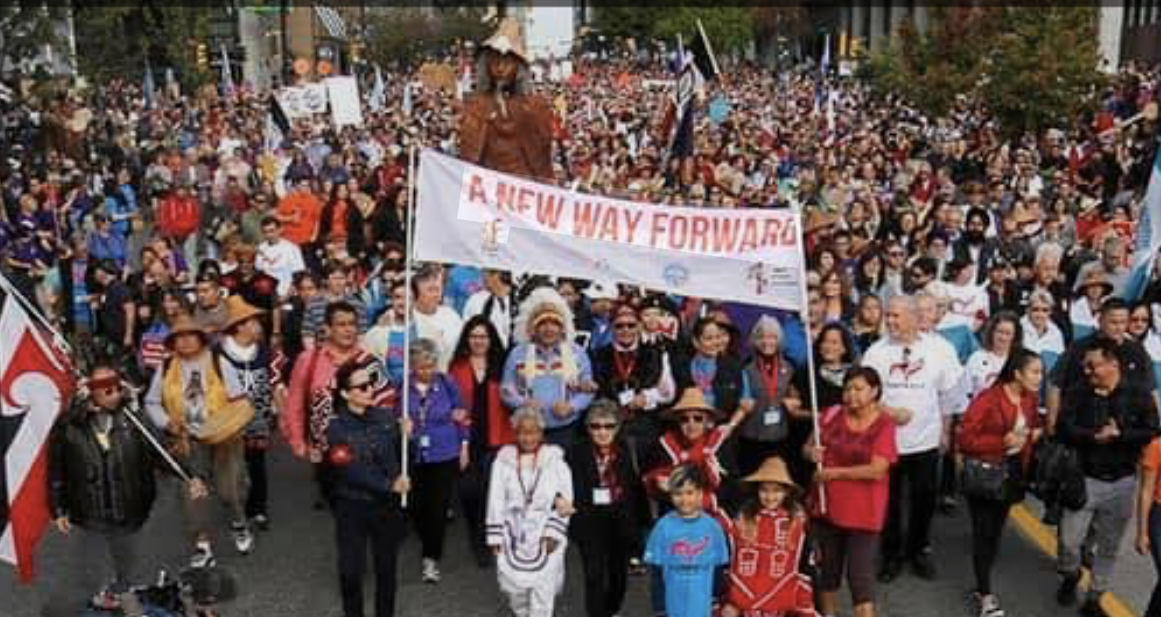
On June 21, Canada will mark National Indigenous Peoples Day, which is the official annual celebration of First Nations, Inuit, and Métis peoples. This year in British Columbia, however, “reconciliation” will be received with far less innocence and enthusiasm than it was five years ago.
In the summer of 2021, Canadians were told that the remains of 215 Indigenous children had been found at the former Kamloops Indian Residential School. An enormous wave of sympathy, anger, and general shame swept the country.
The Canadian flag was lowered, and churches deemed complicit had their steps filled with shoes in memory of the children. Some were lit on fire. Politicians wept, and Prime Minister Justin Trudeau placed a teddy bear on a gravestone in a conventional Catholic cemetery, rather than at a former residential school.
Non-Indigenous Canadians, especially white Canadians, seemed prepared to make amends for residential schools and their well-documented negative effects. Much, if not most, of that goodwill surrounding Kamloops has since been squandered. Not because people disbelieve stories of abuse at residential schools, but because what began as a call to face history has become an arsenal of compelled beliefs, legal privilege, and public exclusion.
It is not as if non-Indigenous Canadians have been unwilling to hear the hard truths associated with residential schools. In fact, they have faced the fire and been publicly excoriated with anti-racism speeches and other campaigns.
The problem is that they took the claims of the Kamloops graves at face value without them being proven. Those who refused to accept and asked questions were socially and politically punished.
Skepticism treated as sacrilege
The University of Calgary’s Frances Widdowson, a tenured professor, was fired for pushing back on the narrative of residential schools, a decision that was later ruled as disproportionate by an independent arbitrator.
Manitoba Premier Brian Pallister was widely attacked after a statue of Queen Victoria was toppled on July 1, 2021 and he defended the contributions of “settlers,” hastening his departure from the premier’s office.
Legal punishment is now being proposed at the highest levels of the Canadian government for anyone noticing that the uncovered facts are not adding up when it comes to the most extreme claims about residential schools.
Even The Globe and Mail, often touted as Canada’s newspaper of record, printed an admission that the claim of 215 children’s remains being located at Kamloops was based on an “extraordinary assertion” that was taken as fact without the necessary proof. The paper confessed that it too had participated in validating the unproven assertion, which, after five years, has yet to be backed up with evidence of human remains at the former Kamloops Residential School.
A normally functioning country with a perfectly sane culture—which doesn’t seem to describe Canada currently—could hold two facts at once: many children died and suffered in residential schools, and anomalies picked up with ground-penetrating radar are not bodies.
However, those with power in Canada have taken to treating well-grounded skepticism as illegal sacrilege. Never mind that vast sums of public money have been sunk into efforts sold as searches for bodies, without results. This also reflects the larger problem of the hundreds of millions of dollars spent on “reconciliation” generally since 2021, without delivering any clarity or quantifiable constructive results.
Criminalizing inquiry
Even worse, the state is now flirting with laws that might criminalize that same skepticism and doubt.
Earlier this month, a Senate committee attempted to amend existing hate crime laws to make “residential school denialism,” whatever that means exactly, into a criminal offence. Had it passed, the amendment would have made it a crime to “wilfully promote hatred against Indigenous Peoples by condoning, denying or downplaying the Indian Residential Schools System”. Proposed jail sentences ranged up to two years.
The Senate as a whole rejected that amendment by a healthy, but not overwhelming, margin of 41-32. That a committee seriously considered throwing Canadians in jail over such vague words as “downplaying” residential schools is thoroughly alarming.
Reconciliation worked much more effectively as a moral appeal than a forced political or legal hegemony. Asking what is truly buried in Kamloops is not bigoted. In fact, asking questions is what reporters and politicians should have done before the country jumped wholesale into a tub of nuanced shame and self-flagellation—myself included.
But better late than never. Because expressing skepticism is not a fringe opinion. And the pursuit of truth is supposed to be a tenet of a free, democratic society.
Reconciliation pendulum swings too far
Writing in Persuasion, journalist Tara Henley noted that 63 per cent of Canadians, and 56 per cent of Indigenous Canadians, wanted further evidence before accepting the claims made about any Kamloops Residential School graves. Still, when it comes to reconciliation, British Columbians are more likely to be thinking about DRIPA and the security of their property than what will or won’t be found in Kamloops.
The Declaration on the Rights of Indigenous Peoples Act (DRIPA), passed in 2019, was celebrated as the enshrining of reconciliation into provincial governance. It was originally presented to legislators by the John Horgan government as guidance principles, rather than a legally binding piece of legislation. But the BC Court of Appeal ruled otherwise in the Gitxaala decision last December when it found DRIPA was justiciable, as in, legally actionable.
The Appeal Court struck down the Mineral Tenure Act because it did not conform to DRIPA, which essentially channels a United Nations declaration into B.C. law. Now every law and statute is open to challenge for not conforming with DRIPA.
Prior to Gitxaala, there was the landmark Cowichan decision. Last August the BC Supreme Court ruling released a dark cloud of of still-enduring uncertainty and market disruption when it not only declared Aboriginal title over private property in Richmond, it ruled that title a “senior interest” over fee-simple propety title.
Then there’s the issue of public parks being closed off by the provincial government in the name of DRIPA and reconciliation. The highest profile was probably Joffre Lakes, which has been shuttered off-and-on to anyone who does not belong to the Líl̓wat and N’Quatqua peoples. One of the most popular summer destinations in the province, access to Joffre is now being rationed based on ethnicity.
The fallout is justified
British Columbians are not dumb, and they are rightfully concerned about their elected government being displaced by a regime of consent that they never voted for. A March Angus Reid poll found more than half of British Columbians think DRIPA goes too far in curbing the power of the provincial government, compared to 44 per cent last August. And in polling from 2025, 69 per cent of Canadians say they better understand why reconciliation is important, but over half believe too much attention is paid to reconciliation compared with other priorities.
According to recent findings from the Aristotle Foundation, $27.2 billion in public money has been spent on BC First Nations by the province and federal governments since 2001. Given the vast amount of money involved, the lack of transparency with how reconciliation is being handled across the board, it’s no surprise perhaps that a demand for accountability is building alongside the public’s growing discontent. Another Angus Reid survey found Canadians split 55-45 on whether Indigenous Peoples should have unique status or the same status as others, and 82 per cent support reinstating federal audit requirements for First Nations spending.
The reconciliation fallout is justified, and it was preventable. Public policy, legal developments and political agendas have taken the reconciliation movement in an unpredictable direction, reshaping the province without consent of British Columbians. People cannot be asked to pay vast sums without accountability, to believe in grievous crimes without proof, and to surrender their access to public land and the surity of their property titles without a voice or a vote.
Reconciliation has careened off course. It is failing because it is being turned into an orthodoxy that most British Columbians, and indeed Canadians, never asked for and don’t want. It has soured their goodwill, and without intervention, we could all be headed into a public backlash of hurricane proportions.