

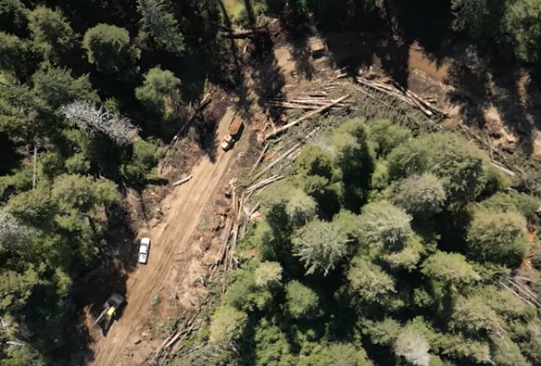
B.C.’s forestry collapse is devastating communities across the province, with provincial policy failures identified as the primary cause. But the dysfunction is causing more than economic losses. It is also destroying two things which are arguably priceless: old growth forests, and a free, fair, and open market.
Old growth logging continues under licences the government has legal authority to restrict. Yet reportedly, less than half of the 2.6 million hectares identified by its own technical advisory panel as most at risk have actually been deferred.
Forest protection advocates point to Canfor and West Fraser as the top two private companies logging old growth. What they omit is that Canfor’s tenures were transferred to two bands in 2024, months after West Fraser’s tenures were combined with a different band’s months earlier—tenures the province subsequently increased by more than 2,000 per cent in 2025. In the same timeframe, the mills these companies used to operate have closed at a steady clip.
Restructuring forestry tenures to broaden participation and competition is a legitimate policy objective, but the ministry’s approach has created an uneven landscape of new risks and inequities. Shifting forestry licenses from existing tenure holders to band-affiliated entities is a deliberate outcome of the B.C. government’s adherence to the Declaration Act and Minister Parmar’s triple political mandate to ramp up logging, conserve more old growth, and increase Indigenous participation in forestry.
On band-affiliated tenure, Crown decisions restricted by ‘duty-to-consult’
This tenure shift amplifies jurisdictional uncertainty around old growth protection because once a band-affiliated entity holds the forestry license, the Crown may lose the ability to step-in and restrict old growth harvesting.
The 2004 Supreme Court of Canada Haida judgment determined consultation is triggered even in cases where a band merely claims an Aboriginal title to land. In the absence of legal proof, such a claim is said to already possess an “economic interest in the land” even though the claim has not been proven in court or settled through a treaty.
Building on this decision, a 2011 BC Supreme Court quashed a ministerial decision after finding the government failed to adequately consult a band that had an interest in developing a hydro power project within a nature conservancy in its claimed territory. The case established that conservation decisions which foreclose economic opportunity in a band’s claimed territory trigger the Crown’s duty to consult, and therefore the requirement for accommodation.
While the Crown argued that preserving land in a nature conservancy is inherently neutral or even beneficial to Aboriginal interests, the judge disagreed and instead stipulated that “proposed conservation measures could have an adverse effect on claimed aboriginal rights and title, as they may limit future uses of land.”
Following an order to consult the Indigenous group again, the B.C. government amended the conservancy boundary.
A ruling this year affirmed a similar logic regarding the economic interests of Gitanyow hereditary chiefs. A judge set aside the Minister’s approval of forestry tenure transfer to Kitsumkalum Band, which had purchased the assets of Skeena Sawmills through bankruptcy proceedings, telling the Crown to “reconsider after proper consultation.”
So it follows, when tenures containing old growth are held by band-affiliated entities, any attempt by the minister to restrict the harvest may be argued to trigger the duty to consult and consider accommodation of the band’s economic interests. This explains the call by some to compensate First Nations to not log old growth forests.
Notably, introducing the duty to consult into the administrative process increases the risk of litigation, something the province is likely aware of and keen to avoid, particularly alongside the legal uncertainty introduced by last year’s BC Appeal Court finding that all laws must conform to DRIPA. Whether the duty to consult overrides the specific terms of a tenure held by a band-affiliated entity is not a question B.C. courts have addressed directly in this context.
Court dismisses compensation claim by non-Indigenous tenure holder
In contrast, the accommodation and compensation requirement does not appear to apply to non-Aboriginal tenure holders.
In 2025, the BC Supreme Court dismissed a claim by Teal Cedar Products that it was owed $75 million in compensation after a BC government-Haida Gwaii management council restricted its harvesting locations. The Court found that neither the province nor the management board were liable to provide compensation, with the justice citing that “the tenure agreements themselves provide the Province with the power to consider and accommodate the impacts of harvesting on both proven and asserted aboriginal rights.”
In other words, the province can make decisions regarding forest management to support reconciliation without incurring any liability to forest tenure holders, assuming those tenure holders are not Indigenous.
The minister is coming for your fibre
Since 2023, B.C.’s actual timber harvest has been about 40 per cent below the total annual allowable cut. The reasons are multi-faceted. Some critics say it’s a sign forestry companies have already logged the best, most accessible, profitable forests and what’s left are “the dregs.” Economists have cited the cumulative impact of “ill-considered or unnecessary” legislation that overlooks commercial needs and economic benefits of a thriving industry.
Forestry stakeholders called out the uncertainty created by arbitrarily reallocating tenure to First Nations as far back as 2021, warning forest tenure transfers would not be at a fair market price because “the government has cleverly changed how it will compensate companies for the reductions to harvesting rights.”
If a tenure holder “chronically fails” to harvest their designated volume, the Ministry of Forests can review the licensee’s performance and potentially reduce their allocated cut, amend the tenure agreement, or outright transfer the timber rights to other operators such as Indigenous groups. In this way, any compensation paid to companies can be “drastically reduced” if government has already lowered their allowable cuts, writes Ben Parfitt of The Tyee.
This all circles back to the tenure shift strategy outlined in Forest Minister Parmar’s triple mandate and offers insight into his explicit warning a year ago: “If you have fibre and you’re not using it, we’re coming for it.”
BC forestry policies fuel dysfunction across the sector
Taken together, B.C.’s strategy results in a structural distortion of a free, fair, and open market that favours band-affiliated entities above all others.
The government set out to save old growth, sustain industry, and advance reconciliation, but it is failing on all fronts.
Provincial policies, in combination with court rulings have crippled the market, biased the tenure system and weakened the government’s ability to protect old growth. Conservationists are alarmed and industry is hollowed out.
What remains is a collapsing forestry sector reliant on an unjust, inconsistent regulatory system, mired in a legal quagmire that satisfies no one.