

BC government cagey on terms of Tahltan ‘consent’ for Red Chris mine
“The province negotiated away our property rights in a backroom deal without involving us or even telling us.”
—Danish Mir
Touting a reconciliation strategy of negotiation over litigation, BC government often chooses to advance the province’s struggling mining industry by offering rich settlements to Indigenous nations following closed-door dealings on land claims.
Rather than risk another loss in court, the province voluntarily ended its historic “free miner” program after a BC Supreme Court judge ruled in 2023 that prospector mineral claims require indigenous consultation before they can be issued. After winning that judgment, the Gitxaala Nation pressed on, with an appeal demanding that B.C.’s Declaration on the Rights of Indigenous Peoples Act (DRIPA) be applied to all provincial laws.
Again, the Gitxaala won, this time to the apparent surprise of Premier David Eby and his attorney general, despite Eby having introduced the DRIPA-related laws referenced in the Gitxaala ruling. The province filed a notice to appeal the decision and the case is now headed for the Supreme Court of Canada.
Back in 2023 at the bargaining table, the Gitxaala took aim at the Yellow Giant gold mine property on Banks Island off the north coast, with its troubled history of tailings contamination from gold and silver processing, and bankruptcy that saw the original owner convicted of environmental offences.
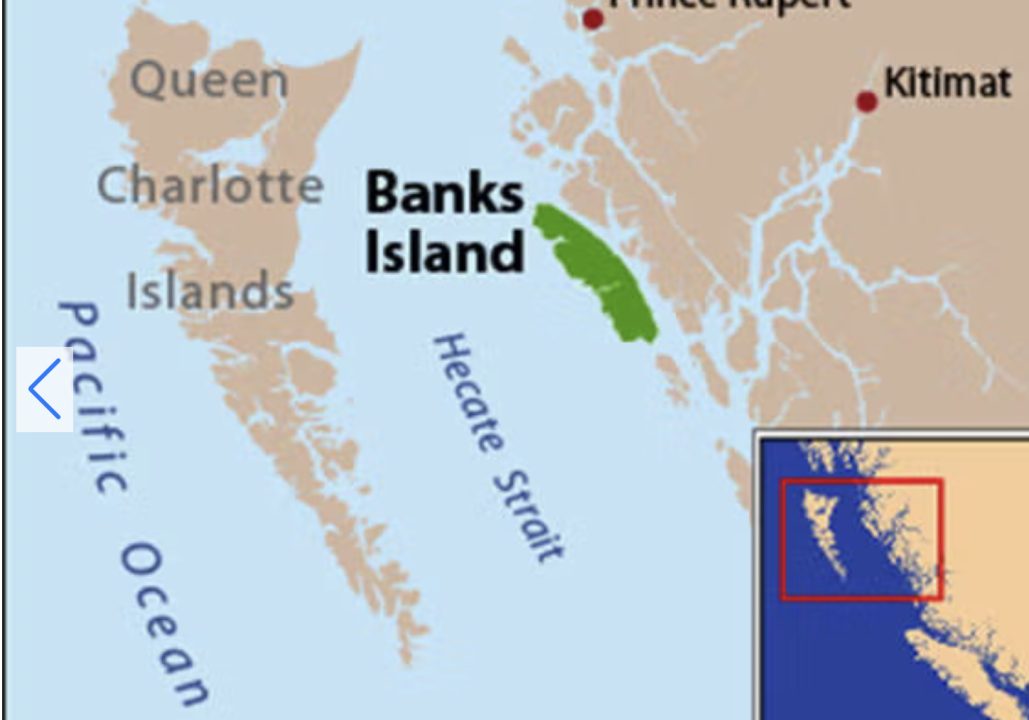
By this time, the Yellow Giant mine had long been under new ownership. MCC Canadian Gold Ventures says it was invited in to clean up and restart the high-grade underground ore site during the term of former BC Liberal mines minister Bill Bennett. The company subsequently obtained a 10-year lease from the province in 2014.
After spending a decade and unspecified millions on engineering, environmental studies and other work, MCC was talking with the province in 2024 about renewing permits when it suddenly learned the site had a new name, according to a notice of claim filed by MCC against the government in the Supreme Court of BC on June 12.
Under two cabinet orders issued March 7, 2024, most of Banks Island became the Lax K’naga Sts’ool Mining Deferral Area. The declaration is similar to the series of old-growth forest deferral areas declared by the BC NDP government in recent years to prohibit logging on selected indigenous-claimed Crown lands.
MCC lawsuit says province gave mineral rights to Gitxaala in secret deal
In a statement accompanying the MCC lawsuit, the company says the province made “false assurances” about its ability to mine, while simultaneously cutting a deal with the Gitxaala to eliminate MCC’s rights. The B.C. government then expropriated the company’s mineral rights without notice or compensation for the work it had completed and used that investment to negotiate a settlement with the Gitxaala.
“The Province specifically asked us to step in and rescue this mine,” company director Danish Mir said. “In return, the province negotiated away our property rights in a backroom deal without involving us or even telling us. That is not how a government should treat investors.”
Lawyers for MCC, Robin Junger and Joan Young of McMillan LLP, see parallels with the landmark Carrier Lumber case of 1999. The lumber company’s timber rights were traded away by Mike Harcourt’s NDP government to an indigenous group without the company’s knowledge or compensation.
Carrier had been brought in to contain a mountain pine beetle outbreak in the Chilcotin Plateau that would later spread and wreak havoc across B.C. and Alberta for more than a decade.
By Bennett’s time in office, his government was working to grow a B.C. mining industry beset by damage claims from Alaska and a tailings dam breach at Mount Polley mine near Quesnel. One of his major successes was the opening of Red Chris, a large-scale copper and gold operation south of Dease Lake.
Located in the so-called “Golden Triangle” in northwestern B.C., the region contains the majority of copper deposits known to exist in Canada. Two of its biggest players are trans-national miner Newmont Corp. and the Tahltan Nation.
Tahltan give ‘consent’ for Red Chris mine under unknown terms
Last week, officials from Tahltan Central Government, Newmont and the United Steelworkers joined Premier David Eby, announcing the approval of the Red Chris mine. It is moving from open-pit operations to a “block cave” underground mine expansion that is expected to extend the mine’s life into the 2040s.
Eby called the Red Chris approval “a story of success” showing how to “do things differently.” The premier described the deal a a “partnership agreement,” the second made under DRIPA’s controversial Section 7 “consent-based decision making” provision. It involves capital investment of “several billion dollars” that has been given environmental permits and approved under B.C’s Mines Act.
Even more importantly in the Eby NDP era, the project has gotten the go-ahead from Tahltan Nation.
“It follows Tahltan Central Government issuing its notice of decision to consent to the project,” the premier’s office states. As in free, prior and informed consent, the core tenet of the UN Declaration on the Rights of Indigenous Peoples that has been embraced by the B.C. government and channeled into law by DRIPA.
B.C. Conservative indigenous relations critic Scott McInnis, MLA for Columbia River-Revelstoke, noted there was no mineral tax revenue sharing or royalty agreement released with the Red Chris announcement. He said it sounds similar to an earlier deal with the Tahltan for expansion of Eskay Creek, a copper-gold property reopening from its underground phase to a new open pit to extend its life. Eskay Creek was the province’s first Section 7 deal to share mineral wealth.
“The last major [Section 7 agreement] is approximately 50-50 between the 3,500 Tahltan members and the remaining 5.7 million British Columbians,” McInnis said. “Hardly a good deal struck for everyone in the province.”
Mine halted by small indigenous group despite $1B invested
The Tahltan and the neighbouring Nisga’a Nation are involved in an even larger Golden Triangle project, the KSM mine near Stewart. Seabridge Gold is developing a site with four open pits and two underground mines, plus twin tunnels for 23 km through a mountain to carry ore for processing and tailings to a remote pond.
The province declared KSM mine “substantially started” in 2024, extending an environmental assessment certificate set to expire in July after multiple extensions. Seabridge says it has spent more than $1 billion, including years of talks with local indigenous groups.
One of those groups is the Tsetsaut Skii km Lax Ha Nation, claiming 56 members who declared themselves a separate nation in the 1980s. They went to court to challenge the “substantially started” decision, supported by environmental group Skeena Wild. On June 9, B.C. Supreme Court Justice Emily Burke ruled that the province failed to properly consult the Tsetsaut Skii km Lax Ha Nation.
As far as the Yellow Giant mine goes, the B.C. government “failed to recognize the destructive impact of its heavy-handed actions” and MCC will pursue the legal course “vigorously and forcefully,” said company director, Mir.
“If this what the government considers Indigenous reconciliation then every investor in B.C. faces grave risk.”