

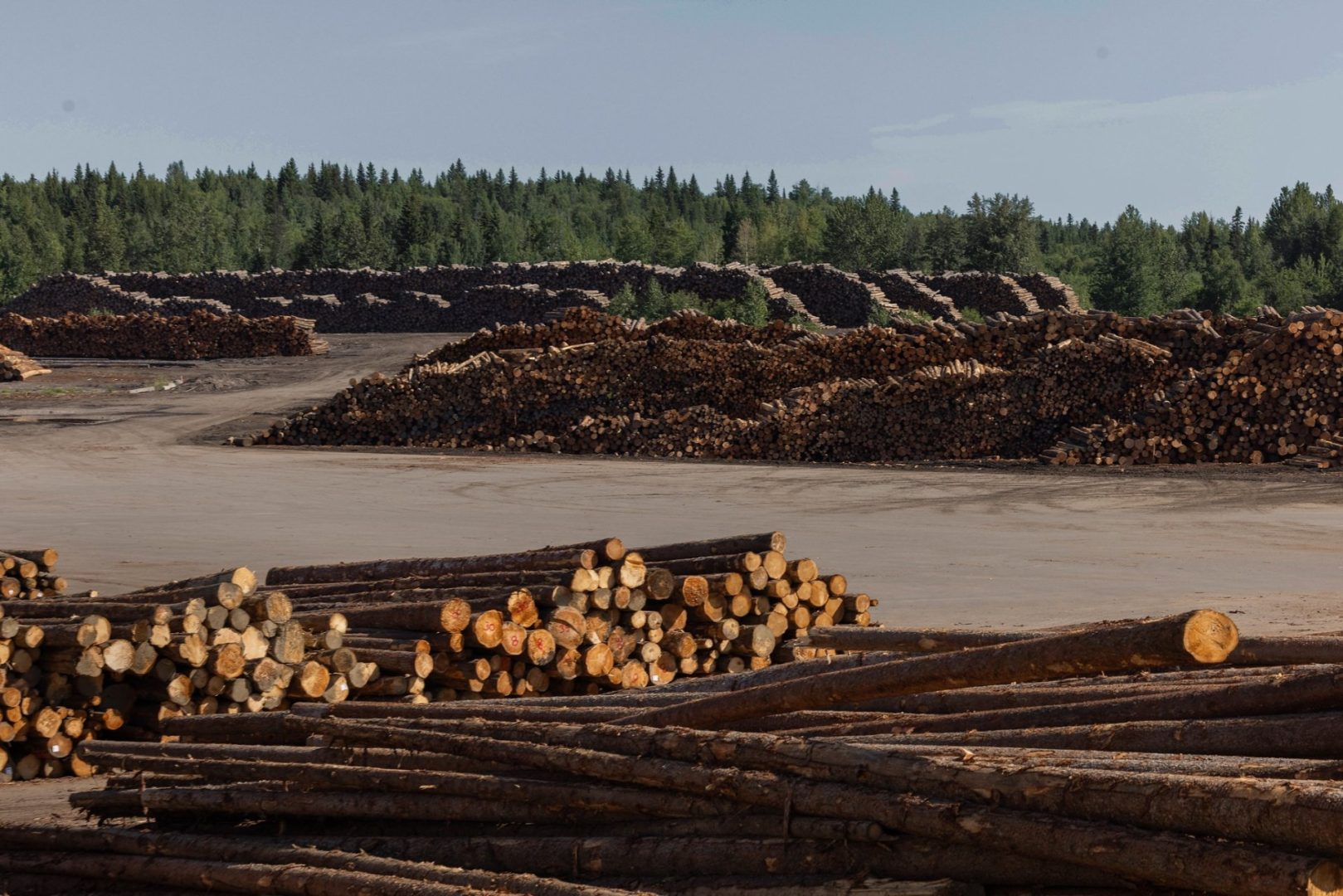
Although the B.C. government continues to blame American tariffs for the collapse of the province’s forest sector, a new task force commissioned by the federal government has backed what the sector itself has been saying for years, in that the main problems exist in homegrown government policies.
The report by the Canadian Forest Sector Transformation Task Force was released Wednesday, as part of a meeting of provincial forest ministers in Langford.
“While external pressures—most notably sustained U.S. softwood lumber duties, global market shifts, insect outbreaks, and wildland fire—have exacerbated these challenges, the Task Force’s conclusion is unequivocal: the most significant barriers to competitiveness are homegrown,” its final report read.
“These include unstable access to cost competitive fibre, regulatory burden disproportionate to risk, chronic underinvestment in manufacturing assets, weak deployment-focused innovation capacity, and inadequately developed domestic demand for wood-based products.”
The task force, made up of business, First Nations and union leaders, called for a federally-led, 25-year national forest strategy.
Ottawa announces $65M for BC forestry projects
“We are taking this advice seriously,” said Federal Natural Resources Minister Tim Hodgson, who attended the meeting on Wednesday.
Hodgson announced $130 million in funding for 56 forestry projects across the country, of which $65 million is earmarked for B.C.
“We will discuss and plan how we can work together as one united Canada to implement the task force recommendations,” he said.
“The provinces and territories will be crucial to this effort, because they are responsible for making the decisions that affect the forest sector on the ground.”
The forestry aid is far short of the billions the B.C. government said it should receive to put it on pair with tariff aid available to Ontario’s auto, steel and aluminium sectors.
However, B.C. Forest Minister Ravi Parmar said it’s still welcome.
“This is a complicated major project, we are talking about defending the interests of forestry jobs, but also repositioning forestry,” he said.
“Forestry, for the last number of decades, has been boom and bust. And we are working together to move it away from boom and bust to civility and certainty.
“We are always going to fight for our fair share here in British Columbia.”
Hodgson pledged two additional forestry plans, one at the end of the meeting this week and another by the end of 2026.
Task force calls for stable access to wood
The core of the task force recommendation is for stable, long-term access to wood and fibre, which echoes years of concern from B.C. forest companies that the most available trees are uneconomical.
Partly, that’s because of provincial policies like old growth protection, as well as swaths of land tied up in Indigenous consultation as part of working tables that have taken years of negotiation and show no sign of concluding any time soon. But the economics are also impacted by global markets, U.S. tariffs and things like the slowdown in housing construction.
The task force called for rapid federal action to reduce duplication and uncertainty in the areas of species at risk and support provinces as they transition from volume-based forests tenures to area-based. The authors also recommended Ottawa create a $10 billion Forest Sector Transformation Fund with loan guarantees to help diversify the sector and attract matching private sector capital.
Some of the report’s suggestions, such as building with more wood, are already policies by the B.C. and federal government as part of housing expansion.
Failing to act, risks $23.5 billion in GDP and nearly 200,000 jobs, according to the report.
The forest sector has seen more than a dozen sawmills closed, 40 curtailments and more than 3,000 jobs lost since last August. The task force said the ripple effect includes harvesters, pulp and paper mills and remanufacturers.