

‘Hell no!’ and other catchy election jingles

Welcome back to our newsletter, everyone!
We are coming to you from behind the frenzied front lines of the snap election political hurly burly that is BC.
I wanted our first missive to be a heavily nuanced overview of what’s happened in the last couple of weeks, but info and events and issues are hurtling toward us like meteors, so we’re going to stick with the central insult to democracy—the snap election.
Here’s the snap narrative unpacked in a high-level, link-laden turkey vulture-type overview.
Enjoy!
—Fran
Great time for a snap election—not
Imagine yourself in an existential bubble of your own making…
Back when David Eby was premier on Sept. 22, he called a snap election.
Snap elections are rarely well recieved by opposition or the public. For good reason. They give unfair political advantage to the governing party and catch the opposition flat-footed, neither of which are usually in the public interest.
“I think our political history indicates, at least in British Columbia, that Premiers use their power to [time]… an election as an aspect of their re-election strategy,” then attorney general Geoff Plant told legislators during second reading of the Constitution (Fixed Election Dates) Amendment Act back in 2001.
The bill committed government to fixed provincial election dates every four years in May (later amended in 2017 to October).
“… general elections in British Columbia will be held not according to the political agenda of a Premier but rather according to a timetable which is fixed, which is certain and which is predictable,” Plant said.
Since then, every premier has stuck to those dates, except for John Horgan in 2020 and David Eby right now.
What if creating confusion is the plan?
Despite multiple word-salad servings about how the election absolutely positively had to be called now so Eby can stand up to Trump and fight for British Columbians imperiled by the “existential moment” he swears is upon us, Eby’s catastrophising has generally fallen ker-splat.
Deep nod to my press gallery colleagues, and other journos, commentators and keyboard warriors thrown into covering this election, for their persistent questioning of the campaign narrative.
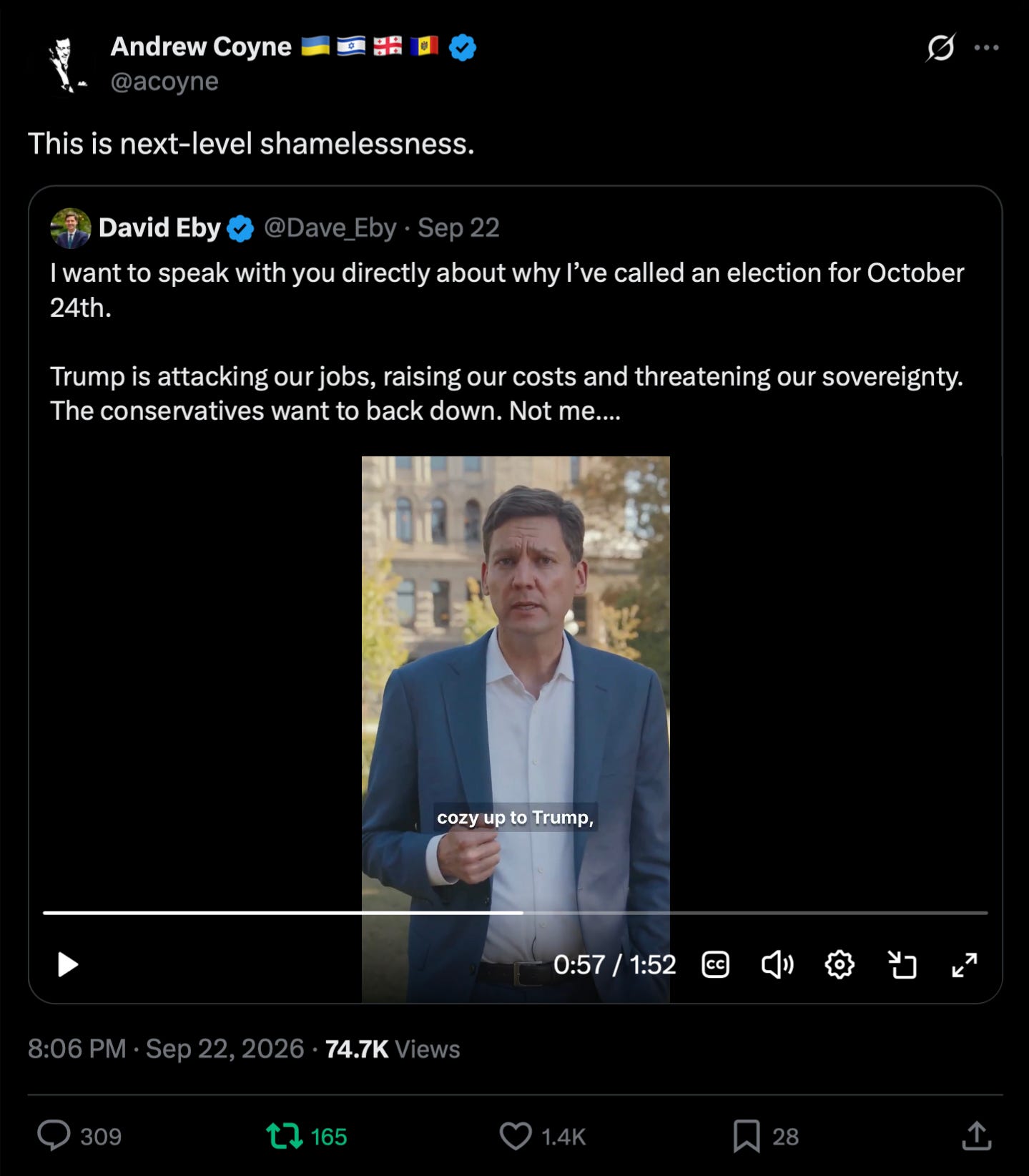
Questionable as the snap election was during the pandemic six years ago, Eby’s current call takes the cake for selfish, ruthless ambition. He called it two days after the leader of the official opposition party resigned, two years before the legislated provincial election date, with a majority government, in the middle of a municipal election.
Mayors implored him to just wait 30 days, arguing it was disrespectful and would interrupt local government democracy. Eby did it anyway. Then he told municipal candidates to “pick a side”—vote for the NDP or vote for the Conservatives. “Are they on the side for their communities… or are they advocates and supporters of the Conservative approach… trying to divide their communities?” he asked Stephen Quinn on CBC’s Radio One last week.
Running overlapping election campaigns is creating massive confusion on street signage and jumbling the issues of both levels of government. But what if creating havoc at the ballot box isn’t just a consequence, it’s a deliberate part of the design of the NDP election strategy? Is that election interference?
Probably not coincidentally, a snap election could quell some discontent within Eby’s own ranks. Members of the NDP (some of them quite senior) are openly musing about his resignation, while others worry he is doing irreparable damage, possibly generational, to the party brand.
In a circumstance like that an election victory could buy an increasingly unpopular party leader a lot of time. Years, or maybe even a whole other term.
How many existential threats does it take to topple a government?
[Note: Existential threat is a danger to our life or existence, like, it’s a super big deal]
So far, Eby has been unable to shake the snap call as anything more than a opportunistic manoeuvre to save his own tanking career and avoid that very important thing he promised he’d be doing right right now. Which was return to the legislature with a resolution to that other “existential threat” he so ominously warned us about back in the spring.
By that i mean, the “significant legal liabilities” created by the ever-worsening DRIPA debacle following the BC Appeal court ruling that all laws must conform to DRIPA. A situation, it must be said, of Eby’s own making, since he introduced both DRIPA in 2019 and the Interpretation Act in 2021, on which the court relied for its decision.
Trying to find a fix for DRIPA and correct the precarious legal situation the province is in, consumed much of Eby’s time and press conferences during the last legislative session. Right up until the day Indigenous leaders from the First Nations Leadership Council threatened to shut down BC in an act of collective resistance if he dared alter a punctuation mark of the legislation. At which point, Eby broke like a hostage under duress and pledged his fealty to attaining their approval.
His team would sit down with the elite group of First Nations leaders over the next several months, in the hopes of arriving at a more “durable solution.” No one, including Eby, his staff, or his attorney general Niki Sharma, are able to define what that means, but that doesn’t stop them from scoffing at people who ask.
What exactly does Eby & co expect to achieve in these negotiations, given the First Nations leaders in question have said unequivocally they won’t change a word in DRIPA? What is there to negotiate?
‘Hell no!’ and other performance highlights
Somehow between the-sky-is-falling and snap election day, the pressure dissipated—voila!
Because while Eby doggedly chased a contrived firebreak metaphor through a wildfire narrative until his pants were on fire, he failed to mention one word about DRIPA in his reasons for calling a snap election. It was all Trump Trump Trump thump thump thump and Canadiana fist pumping. He even threw in an awkward “Hell no!” for theatrical effect.
The Trump messaging was initially perplexing, then just embarrassing. His lobbiest comms team obviously framed his faux election urgency around an epic ‘us or them’ battle of Eby against Trump, with former BC Conservative Kerry-Lynne Findlay as the president’s stand in. Except, too bad so sad for Eby, the Findlay crazy train passed him like Ghost Rider in the night, when she abruptly resigned two days earlier.
Now all he had from his pre-prepared election notes—Where are my notes?!!— was a jumble of Trump-this, Trump-that election rhetoric with no opponent to pitch it at. Interim leader Lorne Doerkson is so far from Trump, even the NDP’s big spending election ad buddies, the Hospital Employees Union, can’t make that connection stick.
And the NDP’s alternate attack is revealing, warning not about Doerkson’s faults of character, but at the spectre of who might replace him after he becomes premier. First, it’s framed on the NDP losing and second, it essentially accepts what everyone knows, Doerkson is a person of high character who would probably make a good premier.
And third, Sharma’s hints about a legal challenge are starting to sound disturbingly like the wigged-up president from down south who’s sued like a maniac against election results he didn’t like.
Imagine an election that canvassed the issues voters care about
The NDP must be running out of material.
Which means, sooner or later, Eby’s going to have to talk about his government’s record and the actual issues assailing British Columbians: street disorder and crime, prolific offenders, rampant mental illness and addictions, the shameful absence of treatment, closed ERs, the debt spiral, a $13.8-billion deficit, what the govt should be doing to protect property title, and more.
And yes, at some point, Eby is going to have to address the fears around co-governance with Indigenous groups unaccountable to the public. And he will have to say the letters D-R-I-P-A and cough up something besides phlegm in terms of a plan.
As Geoff Meggs, John Horgan’s former chief-of-staff, noted on Hotel Pacifica, “He’s not going to get through the election without an answer on that front.”
Maybe not, but judging by his campaign messaging so far, he’s sure going to try.
Be careful what you ask for
We’ll leave the last word to the candidate for Vancouver-Point Grey:
“There’s never a bad time to go to British Columbians and ask [for] the right direction.”
[The last last word will go to voters on Oct. 24]