

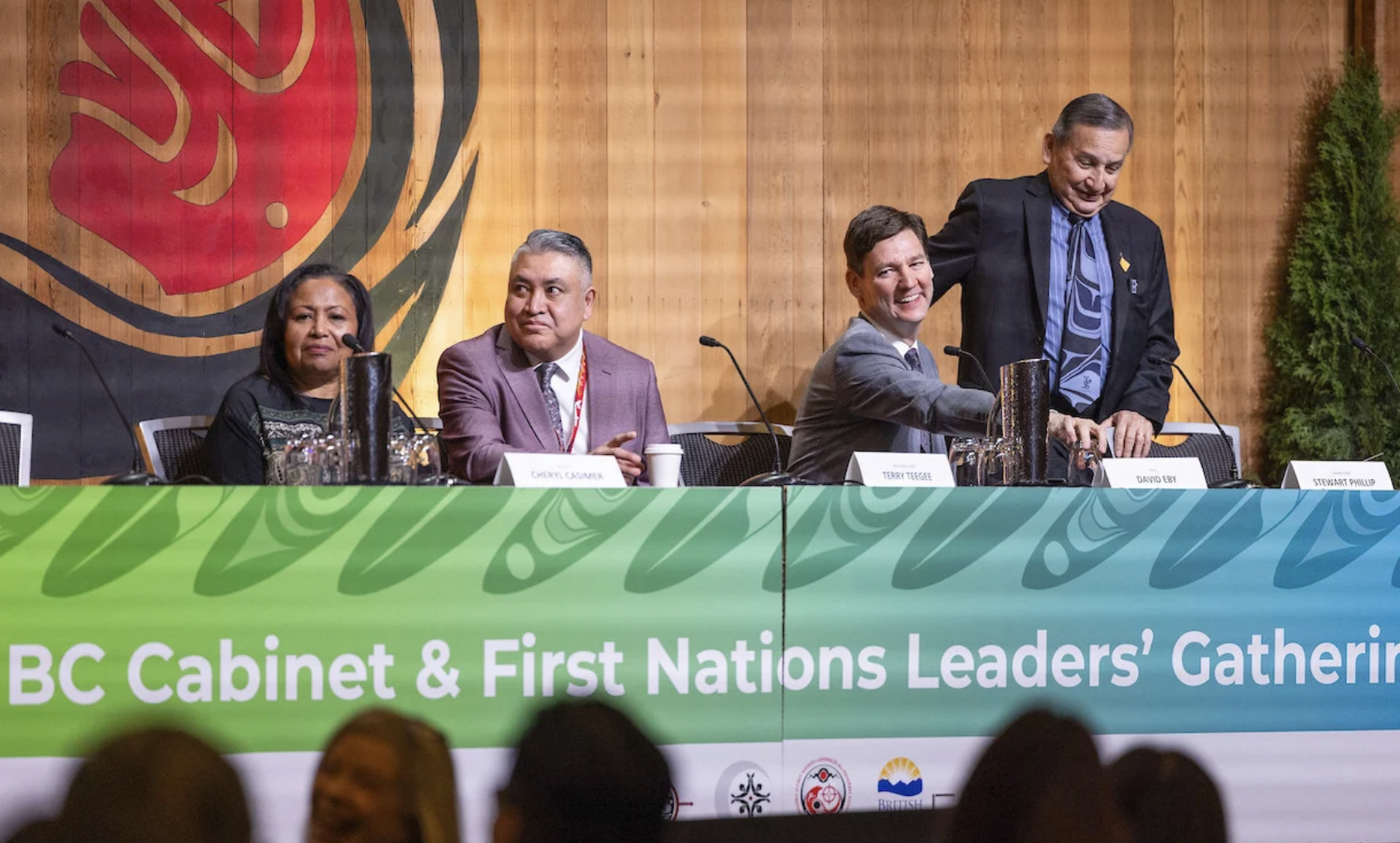
Who is actually governing the province of British Columbia? And who do British Columbians expect to govern this province?
According to a select group of Indigenous leaders, they have essentially been conjointly governing British Columbia with the BC NDP since 2019, when they helped co-draft the Declaration on the Rights of Indigenous Peoples Act (DRIPA) with the late John Horgan’s BC NDP government.
Dustin Rivers, the Squamish Nation politician who goes by Khelsilem, describes this co-governance nirvana as follows:
“In twenty years, First Nations and the Crown govern this province together. British Columbia is a place where First Nations and the Crown make decisions about the land, resources, and Indigenous matters together, as governments that recognize each other. No decision about the land, the water, or the resources of this province gets made without the nations whose territory it is at the table as equals.”
There are about 204 Indigenous communities in B.C., many with overlapping claims. Think for a minute about a Canadian province being co-governed with 204 Indigenous entitites and one provincial government. Would there be 204 different governments? Where would their jurisdiction start and end? Would multiple Indigenous groups co-govern areas with overlapping territorial claims? Who would have final say among “equals” across what is essentially a feudal government system?
Do British Columbians recall giving their democratically elected provincial government a mandate to rule hand-in-hand with activist Indigenous leaders who are completely unaccountable to 98 per cent of the population they’re making decisions for?
Such is the undemocratic reality of adhering to DRIPA, which commits governments and courts to the principles of the UN Declaration on the Rights of Indigenous Peoples. The end goals of UNDRIP for its adherents are co-governance, veto and joint control by Indigenous peoples of a state’s legislative agenda and all land and resource decision-making.
BC Premier is a prime author of his government’s legal quagmire
Unfortunately for British Columbians, last December the Gitxaala v. British Columbia BC Court of Appeal decision ruled that the mineral tenure process did not conform to DRIPA or the related Interpretation Act and so found the B.C. government in violation of its own laws. It further stated that both laws are now legally enforceable in B.C.
Since these laws dictate provincial legislation and regulations must be consistent with the principles of UNDRIP, all laws must now be interpreted through the lens of a UN declaration, despite the government’s stated intention that the UN declaration itself should not be the law in the province.
The BC NDP, starting with the late John Horgan, brought this muddled state of legal affairs onto themselves—both bills were introduced by David Eby when he was the Attorney General.
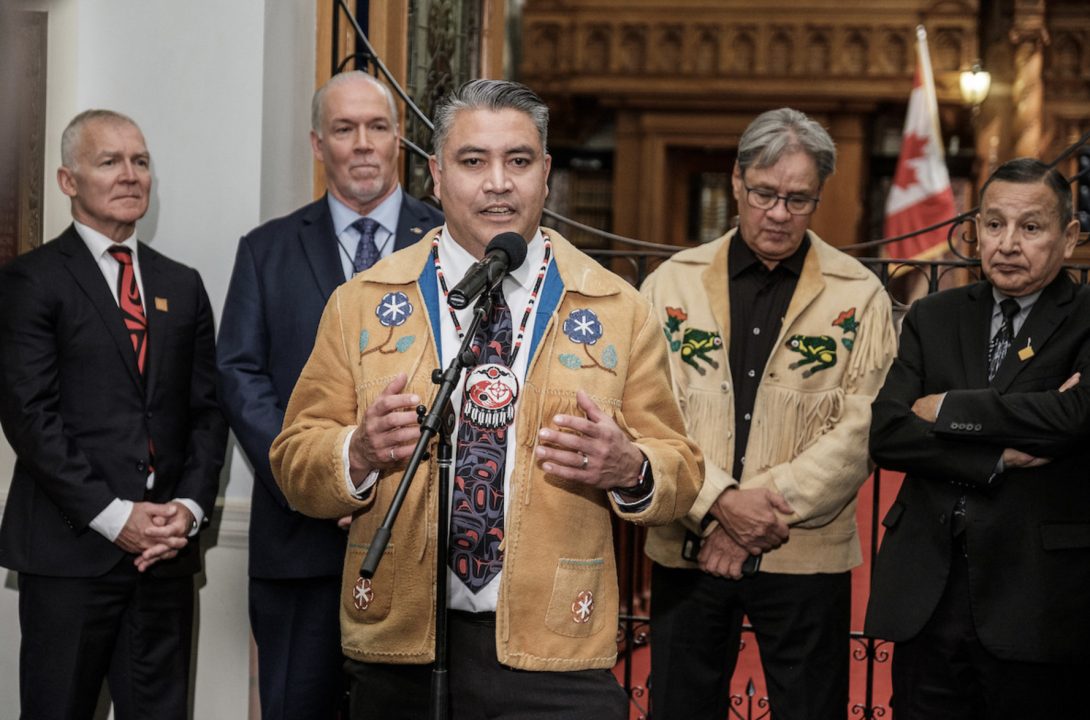
Despite the seemingly unambiguous wording added by Mr. Eby to the Interpretation Act: “Every Act and regulation must be construed as being consistent with the Declaration,” the premier now says that was not government’s intention when it passed the bill. Indeed, when government introduced DRIPA in 2019 and section 8.1 of the Interpretation Act in 2021, officials professed both would be implemented in accordance with Section 35 of the Constitution, which effectively recognizes and promotes Aboriginal and treaty rights in Canada.
The problem is that UNDRIP does not align with Canadian law. Where constitutional law requires strict proof of occupation before courts will recognize Aboriginal title, UNDRIP simply accepts all vast territorial claims as Indigenous-owned without a need for evidence. The UN declaration further dictates these territory “owners” are entitled full land-use decision-making, amounting to co-governance.
It’s no wonder the that the Indigenous leaders who helped co-develop DRIPA are now adamant against the premier so much as altering it. Almost all of British Columbia is subject to territorial land claims.
Just as understandable is government’s urgent need to disempower DRIPA and the Interpretation Act. If UNDRIP principles are “the law” and asserted territory is “owned” by whichever group lays claim, then the province’s land base is owned by 204 First Nations, each of which would carry out so-called “inherent” decision-making over its use.
So began the government’s current scramble to try to make the Gitxaala decision moot by amending or suspending key sections of DRIPA to take away provisions the BC Court of Appeal relied on to make DRIPA and UNDRIP justiciable, or actionable in law.
The Premier has floated at least two iterations of proposed amendments, the last being a three-year “pause” of certain provisions of DRIPA, ostensibly to cover the time until government can appeal the decision. But Indigenous leaders have cried foul to any amendments or suspension of DRIPA. Even a portion of the premier’s own NDP MLAs are reportedly insisting no changes are acceptable and the province must accept UNDRIP as the law in B.C. – no matter the consequences.
Pushback on tinkering with amendments seems nearly universal across the political spectrum. Opposition Conservatives, along with business groups, municipalities and others are calling for both DRIPA and the Interpretation Act to be repealed.
Do First Nations have effective veto over BC legislation?
Another complication for the premier is that key First Nation leaders now appear to view DRIPA as a piece of legislation the government cannot alter without their express consent, as a result of the Gitxaala decision.
Article 19 of the now legally enforceable UNDRIP says “states shall consult and cooperate in good faith with the Indigenous peoples concerned through their own representative institutions in order to obtain their free, prior and informed consent before adopting and implementing legislative or administrative measures that may affect them.”
According to this argument, government cannot even attempt to amend DRIPA without the “free, prior and informed consent” of the Indigenous peoples of this province, presumably as represented by the activist First Nations Leadership Council.
The premier seems to have accepted this ridiculous and completely undemocratic interpretation of UNDRIP as B.C. law. Paralyzed by the entrenched opposition by First Nations, and apparently unwilling to act without their consent, the premier has already effectively given an elite group of Indigenous leaders, unelected by the wider public, a veto over British Columbia law-making.
This is the inevitable and desired evolution of DRIPA Indigenous leaders have been seeking all along.
DRIPA’s original promise is broken
The Declaration on the Rights of Indigenous Peoples Act is a short piece of legislation passed unanimously by the legislature in 2019 under the late John Horgan’s government. Back when the bill was first debated in the legislature, government officials promised “no new rights” would be created by DRIPA, and that it would conform completely with Aboriginal rights contained in Section 35 of the constitution. Whether sincere or not, that intention has not borne out.
At its core, DRIPA creates an undemocratic bilateral process involving the First Nations Leadership Council and the government jointly deciding which B.C. laws will be amended to align with UNDRIP, with no public input whatsoever.
Sections 6 and 7 in DRIPA allow for similar undemocratic agreements with Indigenous governments. “Joint “or “consent-based” decision-making (also known as a veto) confers statutory authority to the Indigenous party over the use of Crown lands. Numerous reports from the mining and resource sectors indicate this veto is already being leveraged by some Indigenous groups to demand money from industry in exchange for their consent to develop a project. If the company refuses to pay, consent can be withheld, and government permits for the project are not issued.
The federal government also passed its own version of DRIPA in 2021, in a move not based on thoughtful legal analysis. What complications will yet flow from this federal legislation is unclear. If B.C. is any indication, Members of Parliament will come to regret their enthusiasm for UNDRIP, because a fully and literally implemented UNDRIP will create unmitigated chaos and virtually unlimited government liability.
Premier Eby has now basically admitted as much, citing the 20 or so court cases relying on UNDRIP, DRIPA and the Gitxaala decision to challenge B.C. laws.
Despite this, the B.C. government has charged ahead, imbedding UNDRIP in two new treaty agreements now before the legislature. Like all treaties, the Kitselas and K’ómoks treaties will be constitutionally protected agreements. The first signed since DRIPA was passed, each of these treaties references UNDRIP as the “minimum standard” for Indigenous rights and “an authoritative source” for the interpretation and implementation of the treaty.
Since UNDRIP is in many respects inconsistent with section 35 of the Constitution, the interpretation and implementation of these treaties may ultimately not conform to Canadian law as a result of these provisions.
BC is already being co-governed
We should pause to consider what is going on here.
The Premier has called the situation an “existential threat” yet appears paralyzed to take decisive legal action.
Is he now so beholden to specific Indigenous chiefs for his legislative agenda that gaining their approval supersedes his fundamental obligations to the 5.7 million other British Columbians who are threatened by his inaction?
Government-by-minority groups is not “reconciliation.”
Any legislation that enables an activist elite group, Indigenous or otherwise, to highjack the legislative agenda of a freely elected government and co-govern without the informed consent of its public is an existential threat to democracy itself.
DRIPA and UNDRIP are not solutions to anything. They are recipes for undemocratic chaos.
B.C. must repeal DRIPA and disempower UNDRIP. The province’s legal, political, economic, and societal prosperity depends on it.