

Northern B.C. mayors and councillors have endorsed a call for the province to protect private property rights and increase transparency around Indigenous rights and title negotiations.
“Reconciliation and private property can and should coexist,” said Pouce Coupe councillor James Wall. ”We can work on the problems that have been created, and advance people and create better lives, while maintaining private property.”
Wall introduced the motion demanding the B.C. government “affirm and uphold” the security of fee simple property titles at the annual North Central Local Government Association gathering in Prince George last week.
A second motion from Pouce Coupe, introduced by mayor Danielle Veach, directs the province to create a “transparency framework” to share information and consult with affected local governments during Indigenous rights and title negotiations.
“As the elected representatives, we need to be connected to what impacts our residents and our regions,” Veach said. “We can provide that information in collaboration with the province and First Nations governments, so that people are informed. It’s that simple.”
Without better communication, she added, “People feel blindsided.”
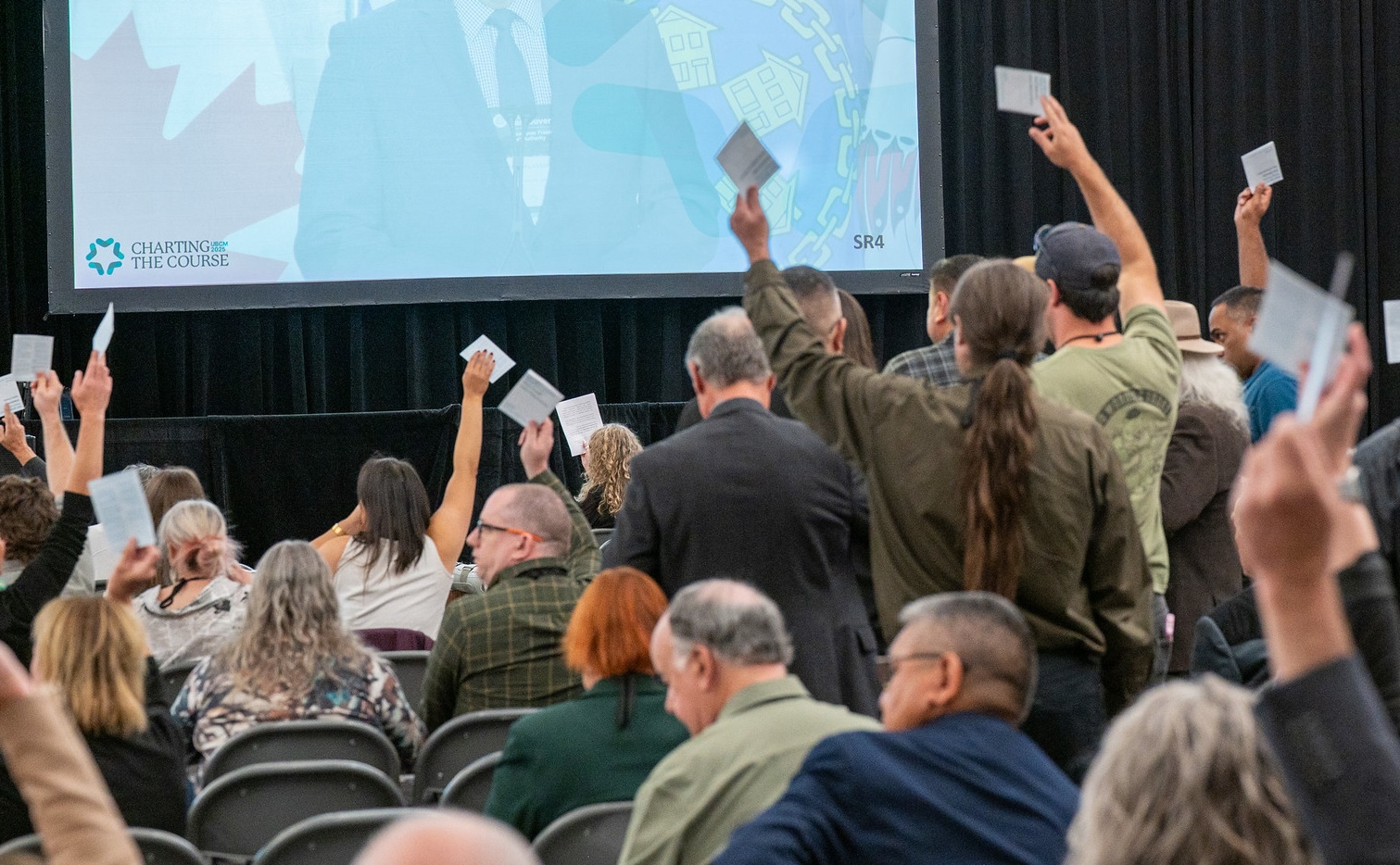
Both motions were endorsed by a majority of northern local government officials and will now advance to the annual Union of BC Municipalities conference in September for a province-wide debate to determine if they should become priorities of the organization’s discussions with the B.C. government.
Security of property rights uncertain
The security of property rights was thrown for a loop following the BC Supreme Court Cowichan Tribes decision last August, which found Aboriginal title on 800 acres of industrial, retail and private property in Richmond. For the first time ever, a court found Aboriginal title could co-exist with private property rights and was a “senior interest” over fee simple private title.
Adding to the uncertainty, in 2024, the province negotiated the Haida land title agreement, marking the first time in B.C.’s history Aboriginal title was recognized by government over private property. And one month after the judge in the Cowichan case ruled that a court declaration of Aboriginal title nullifies Land Title Act protections of private property, the provincial and federal governments quietly supported Haida’s application to entrench their Aboriginal title into constitutional law via a court declaration.
Then, in February, the federal government signed a rights recognition agreement with Musqueam Indian Band, recognizing Aboriginal title over an unknown portion of the group’s massive territorial land claim, covering much of Metro Vancouver.
Government secrecy across the “reconciliation” file is also fuelling anxiety.
The B.C. government will not say how many Aboriginal land title cases are ongoing. Several American tribes are petitioning the courts over rights, title, land and resources in B.C. and there is an Aboriginal title case involving public land near Coquitlam and a 1.25-million-hectare claim that includes the city of Kamloops, along with a steady stream of land use agreements being negotiated by the province with Indigenous communities across the province.
B.C. Premier David Eby said he disagrees with the Cowichan finding and has committed his government to appealing the decision, although it’s unclear on what grounds.
Private property needs to be ‘off the table’
With all these lawsuits in play, it’s hard to understand what’s going on, so people are wondering, “are they after this land, or are they not?” said Houston mayor Shane Brienan, who supported both Pouce motions.
Brienan called the demand to protect private property a “no-brainer.”
A provincial commitment to protect private property title will help establish “a starting point that some things are off the table.”
He also supported the call for greater transparency in Indigenous negotiations.
“We just wish a lot of times we were either all at the table together or in the same timeframe,” he said. “I know we have to work through all these things, and we have to get to some kind of agreement in place, but a lot of times… it just sort of comes down, like, ‘Okay, this is what’s been decided.’
Local communities need to have more input, he said.
While an estimated 90 per cent or more of local officials who voted appeared to have supported the Pouce Coupe motions, there were a few holdouts. Most declined to share their perspectives publicly, but Terrace councillor Sarah Zimmerman explained her reasoning.
“I kind of felt with the property rights one that the wording oversimplified a really complex constitutional and legal issue that’s before the courts and didn’t really reflect the layers of complexity that this conversation needs,” she said.
The councillor also took issue with how the motion was phrased. “This is only resolution out of the entire package that uses the word ‘demand.’” Zimmerman would’ve preferred “more constructive language, like ‘urge,’ ‘call upon,’ ‘encourage,’ ‘request.’”
While supporting “the spirit” of the transparency motion, Zimmerman opposed that as well because she worried it was referring to treaty negotiations. In hindsight, she said, she might endorse it at the annual conference in September.
Security of private property remains uncertain
It’s unlikely any of these issues will have abated by fall, but the Cowichan case may have new developments.
Montrose Properties, the largest private landowner in the Aboriginal title area, is seeking to re-open the case to argue for private property owners’ perspectives to be heard. This month, Montrose wrote Prime Minister Mark Carney, asking the federal government to join its effort to reopen the case and to argue Aboriginal title is “extinguished” on pre-existing private property title.
Carney has not responded publicly to the request from Montrose. Hearings begin this week.
In a letter shared with Northern Beat, the company revealed it also wrote to B.C.’s premier and attorney general last year, asking them to “advance all available arguments” on the appeal, including extinguishment of Aboriginal title.
Historically, both governments have argued that Aboriginal title is extinguished on pre-existing private property. However, while the Cowichan lawsuit was ongoing, then federal attorney general, Jody Wilson-Raybould, and then B.C. attorney general, David Eby, both issued directives, forbidding their lawyers from using the extinguishment argument in the name of advancing reconciliation.
Only the City of Richmond argued Aboriginal title was extinguished on private property in the Cowichan case. Not having the senior levels of government engage this argument weakened landowners’ case, according to some Aboriginal law experts.
Attorney General Niki Sharma skirted the question when asked this week if Montrose had requested the province join the case and argue extinguishment. The government has said only that it supports Montrose in seeking a reopening of the case.
“They’ve asked for an opening up of the trial because they weren’t a party, and they feel that they should have been, so we’ve been supportive of that application,” Sharma said on Thursday.
Montrose and other Richmond property owners only learned their land was within the Cowichan claim area after last August’s judicial decision was handed down, so, property owners had no opportunity to defend their title interests in the court proceedings. At any time during the nine years of the Cowichan Tribes proceedings, Cowichan, the federal, provincial and Richmond governments or the other defendants could have informed local residents about the title claim over the Richmond area. None chose to do so.
In its letter to the B.C. government, Montrose also asked the premier and attorney general not to make any commitments in their ongoing negotiations with Cowichan “that could affect private landowners’ interests, without first providing us an opportunity to consider and comment.”
Property title debate hits the House of Commons
Months after the Cowichan decision rototilled the foundational protections of land title in B.C., the issue of private property surety will finally hit the national stage.
The Opposition federal Conservatives have a motion on the floor of the House of Commons on May 25 to call on the Carney government to repeal its litigation directive forbidding Crown from arguing extinguishment.
“Almost 10 months after the ruling threatened the homes of [hundreds] of Richmond residents, with possible repercussions for all British Columbia homeowners, the Prime Minister, who is responsible for the defense, continues to instruct his lawyers not to do anything to defend your rights and your property,” Conservative leader Pierre Poilievre said in an interview.
“So, frankly, it’s time for Mark Carney to stop hiding under a rock, reverse the disastrous instructions he’s giving federal lawyers, and tell them to argue to put property rights first in the appeal.”
Poilievre said he backs Montrose Properties in its efforts to re-open the Cowichan decision in BC Supreme Court.
“It should be re-opened,” he said. “But the problem is that, if it were re-opened today, Mark Carney’s instructions to federal lawyers is for them not to argue for property rights.”
Carney has told the House of Commons his government will defend private property rights and he “fundamentally disagrees” with the BC Supreme Court ruling on Cowichan.
His party will now have to vote on the motion, which also calls on the federal government to not sign any more agreements with First Nations without explicit property protection language and to ensure all fee-simple property rights are enshrined in deals.
“All the Liberal British Columbia MPs will have to show whether they stand up for homeowners, or whether they side with the Cowichan ruling that threatens home ownership,” said Poilievre.
‘We’re all British Columbians’
People have a right to fully understand their property rights, said Terrace mayor Sean Bujtas, who supported the Pouce resolution.
“This is just asking a question to reaffirm people’s rights of their own property. It’s not asking much. And they might reaffirm to investors that [they own] their property too.”
Bujtas shrugs at endorsing the call for greater information-sharing and consultation with municipalities on matters affecting their residents.
“Asking for transparency anytime seems like a reasonable thing,” he said.
For Veach, being transparent is what a good government strives to do.
“This is your provincial government, they represent you, so if you ask for something, you should be able to get it,” Veach said. “If the taxpayers are abuzz and saying, ‘What does this mean? What’s going on?’ you don’t just get to shut the door and go, ‘No, no, no, we’ll let you know after.'”
Pouce Coupe is in Treaty 8 territory. The tribal council says, “We are all treaty people,” notes Veach. “Because every single one of us lives under Treaty 8. So it’s not I’m a treaty member and you’re not. No, we are all treaty people, because the treaty affects every single one of us.”
In the same vein, we’re all British Columbians, she said.
“We should be part of the conversation. This is our home as well. This is everybody’s home.”