

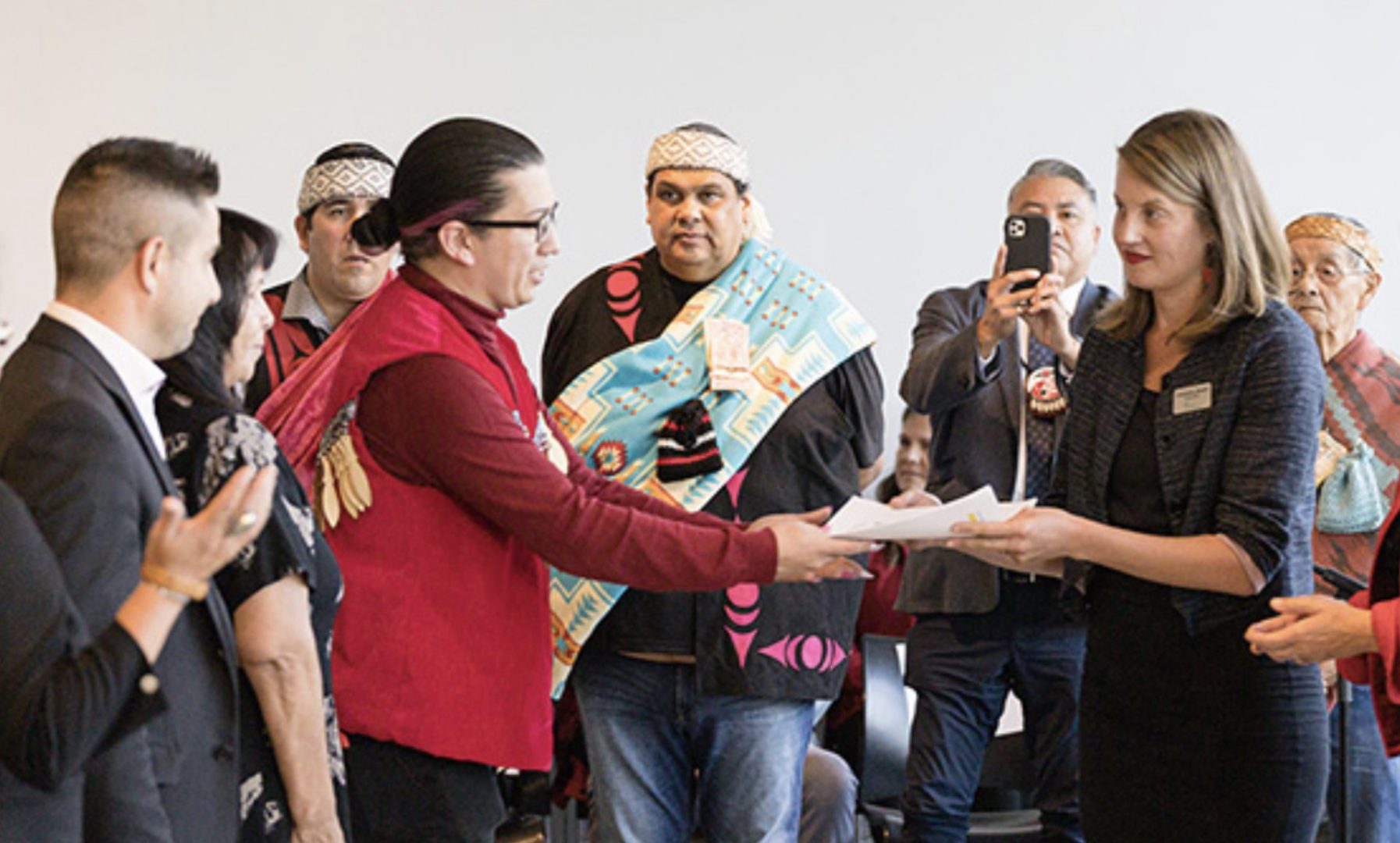
Overnight, the Cowichan Tribes court decision upended public perception of Indigenous reconciliation when it recognized Aboriginal title over private property in Richmond. But three years earlier the signs were already there when Vancouver city council adopted its own radical strategy to reconcile with regional Indigenous groups, changes that have begun rolling out.
On Oct. 22, 2022, with little debate, less media coverage and almost no public awareness, Vancouver city council unanimously endorsed the recommendations of its UNDRIP task force, the committee formed to oversee the implementation of the United Nations Declaration on the Rights of Indigenous Peoples in the City of Vancouver.
Most councillors likely didn’t take the report literally or seriously in 2022, but they feared voting against it prior to a civic election when accusations of racism and even genocide were common. In voting approval, however, they turned its extreme recommendations into official policy, perhaps thinking if unfortunate consequences followed, they could send them for a staff review to give the excesses somewhere to die.
Taken on its face, the city’s UNDRIP strategy is an astonishing read.
If the strategy has gotten any attention, it has tended to focus on the aspects incorporating Indigenous art, culture and language into the city scape. But the more crucial task force recommendations undermine the powers of local government and its legal authority, putting the city’s tax base at risk, depriving its citizens of democratic accountability from their institution, and ultimately changing how residents are governed.
Under UNDRIP, all land claimed is land owned
Vancouver city councillor and task force co-chair, Christine Boyle, now B.C.’s Housing minister, introduced the motions that framed the strategy with a pledge to recognize Musqueam, Squamish and Tsleil-Waututh as the “rights and title holders… within the meaning of UNDRIP” and a commitment to “repudiate colonial concepts of Doctrine of Discovery and terra nullius [nobody’s land].”
This is important, because none of these groups have proven the extent of their Aboriginal rights and title under the Canadian constitution. And UNDRIP does not require any legal proof of occupation as stipulated under constitutional law. Instead, UNDRIP simply accepts all asserted territory as Indigenous-owned with the right to decide its use.
Which leads to the recommendation that the city “identify priority parcels of land which are culturally, economically, and socially significant to be repatriated with the end goal of having those lands given back.”
Given UNDRIP’s easy acceptance that land claimed is land owned, these parcels could arguably extend anywhere in Vancouver. Coupled with the wide latitude given by the BC government as to what potentially constitutes “culturally important” sites, the “land back” options become alarmingly open-ended.
When parks, school properties and civic spaces are considered for transfer to an Indigenous group (as the City of Squamish appears to be doing), it stirs controversy, drawing conflict over access and use, and raises questions about where taxation dollars will be directed and which party will retain development rights.
Among other extreme elements in the “UNDRIP action plan” is the recommendation to find ways for Musqueam, Squamish and Tsleil-Waututh to assert greater influence on city strategies, plans and projects “based on genuine free, prior and informed consent rather than mere consultation.”
This type of consent-based decision-making, lifted directly from UNDRIP, has become more prevalent in land use agreements between the provincial government and Indigenous communities. In Vancouver’s case, it would give de facto vetoes to three Indigenous groups that have no direct democratic accountability to any community, save their own.
Indigenous groups could influence growth more than city council
At the time the strategy was adopted by Vancouver city council, many of the recommendations came off as woefully naïve: prioritize Indigenous participation for all projects, including large and small infrastructure, provide funding and resources or land to support Indigenous-led housing developments.
But seen in today’s context— following the Cowichan Tribes BC Supreme Court finding of Aboriginal title over private property in Richmond, and the Gitxaala BC Court of Appeal decision that ruled all laws must be interpreted through the lens of UNDRIP—the city’s action plan becomes more concerning.
The Vancouver planning department has affirmed that any area with an Indigenous overlay supersedes the policies that might constrain other developers. It’s a message reinforced by Indigenous leaders themselves.
“… we’ve just learned the secret of making [projects] go quicker … If you have developments that are facing six-year, 10-year delays, come see us. Let’s move,” said Bernd Christmas, the former CEO of Nch’ḵay, Squamish Nation’s economic development arm.
The Squamish, Musqueam and Tsleil-Waututh Nations own the MST Development Corporation, which reports $3 billion in housing and land ownership in the Lower Mainland. With the powers provided through the city’s UNDRIP strategy, particularly the generous interpretation of “land back,” these Indigenous groups could eventually shape the growth of Vancouver more than its city council.
‘Restoring’ Indigenous law will open city to liability
That’s not all for the recommendations with startling implications.
Another action item recommends the city Identify ways “to restore their Indigenous laws (and to) weave them more fully into local decision-making processes, including each nation’s own legal review of the city’s projects and plans.”
Incorporating each group’s “own legal review” will no doubt result in multiple, possibly competing, Indigenous interpretations, causing disputes over which jurisdiction is superior versus a legal system rooted in “colonial” legislation.
Legitimatizing the concept of Indigenous legal review will undoubtedly open the city to liability risks since something will inevitably go wrong and parties will look entities to blame. The strategy also raises questions about where funds derived from the property tax base will be spent because there are at least a dozen recommendations that will rely on the city’s resources.
Also in the strategy are nebulous new concepts and processes that recommend ceding decision-making to select leaders of less than two per cent of the city’s population, notably the open-ended commitment to ensure “diverse Indigenous populations,” are “represented in decisions which impact their lives, including access to services, quality of life, and reflection in community.”
The most existential change stemming from the strategy would transform governance of Vancouver and, hence, the status of its citizens.
Should representatives of MST development corporation sit as members or delegates on governing institutions in Vancouver, making decisions of legal consequence but without municipal status?
The task force seems to say yes.
Rooting out “embedded colonialism”
The strategy also suggests creating an UNDRIP intergovernmental body co-governed by Musqueam, Squamish and Tsleil-Waututh and the city to facilitate the action items. It recommends Indigenous representation on Vancouver Park Board, Metro Vancouver Board and other regional boards, such as the Board of Trade), planning tables, and other committees, with compensation for their participation.
In a separate motion, council agreed to encourage the Board of Parks and Recreation, Vancouver Police Board, Vancouver Public Library Board, and Vancouver School Board to adopt the findings and “collaborate in cross-departmental implementation to ensure their own policies and procedures align with UNDRIP.”
Justified in the name of decolonization, the strategy not only seeks to dismantle self-evident assumptions of representative government as laid out in the Vancouver Charter but also to proactively “look for embedded colonialism within its systems.”
Embedded colonialism is undefined, but those searching for it will no doubt find it, especially in the collective history created by “settlers” and adopted by immigrants who continue to arrive.
With a fluid definition of colonialism, and a re-adjudication of past actions and current policy, especially by the courts, the truly radical character of the task force becomes apparent. It ends up questioning the sovereignty of elected representative government.
Within academia, the more radical adherents to the decolonization/land back ideology say the question of sovereignty is key for a critical understanding of what “reconciliation” is really about.
“[The settlers] can stay. But they need to come under somebody else’s governance,” said Kim Tallbear, Canadian research chair in Indigenous Peoples at the University of Alberta.
Leaders must resolve the questions, address the doubts
The city’s UNDRIP strategy has not been fully implemented, but the action plan lays out next steps, priming expectations for Indigenous people, and as the province learned when trying to walk back its own UNDRIP-related legislation, the stakes are huge and the divisions run deep.
History is clear that people, whether Indigenous or colonial, respond defensively and often aggressively when their lands, laws and identities are threatened, especially when they are taxed without accountable representation.
When radical policies are implemented without adequate public and legal review, without transparency, and without democratic accountability, the results can be disastrous, economically and societally.
When those making decisions affecting the public interest are not ultimately accountable to voters, that is not governing, it is ruling.
The aim of the strategy to achieve “a mutually respectful framework for living together” is good. The desire for justice and genuine reconciliation is a goal shared by most British Columbians.
But Indigenous and non-Indigenous leaders must recognize the dangers, resolve the questions, and address the doubts embedded in the city’s strategic plan. Until they ensure the protection of the sovereignty of our elected government and, in concert with the public, agree on the direction we need to take, the best action plan for this strategy is to shelve it.