

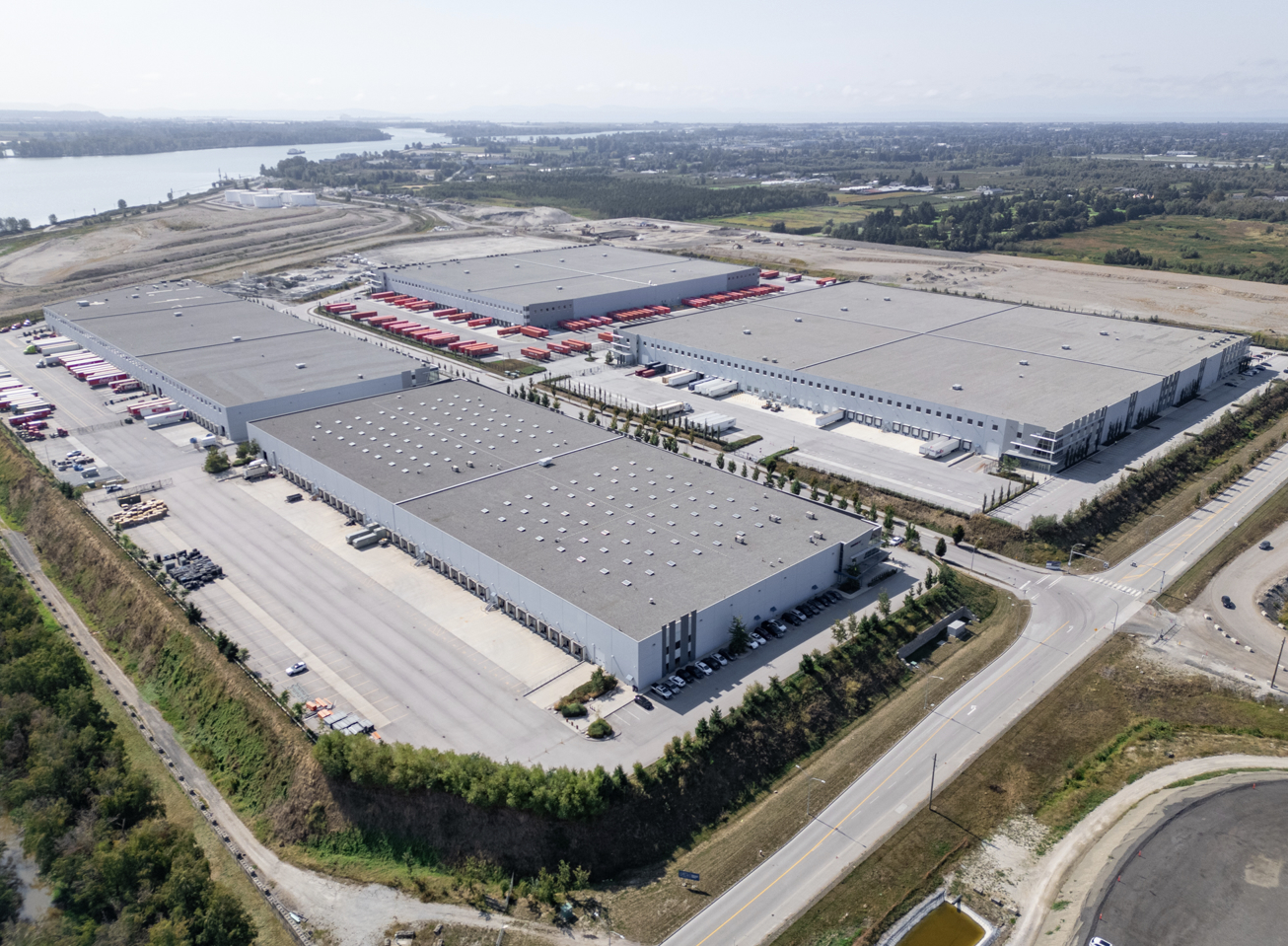
The largest landowner in the Richmond area affected by the Cowichan Tribes’ Aboriginal title victory is appealing to Prime Minister Mark Carney for help.
Montrose Properties, which owns an industrial park in the area that includes distribution centres for Coca-Cola, Canadian Tire and Wayfair, is asking Carney and the federal Liberal government to restore the argument that existing private property extinguishes Aboriginal title in Richmond, and present this argument in court alongside Montrose as it attempts to re-open the BC Supreme Court trial.
It amounts to a call-to-arms for the federal government to re-enter the fight on a case with which Prime Minister Mark Carney has told the House of Commons he “fundamentally disagrees.”
“While we acknowledge that it may be somewhat of a delicate issue for the Government of Canada (to) now take a position before the court, we also appreciate that (as previously noted) there is now a new Attorney General and a new Prime Minister in office, and we believe the Court has the discretion to hear from the Government of Canada on this issue if it chooses to do so, given the extreme importance of these issues to all Canadians,” Montrose CEO Ken Low wrote in a letter to Carney this week, obtained by Northern Beat.
The Cowichan Tribes BC Supreme Court ruling in August found Aboriginal title is a senior right to fee-simple private property, sparking anger, confusion and concern amongst political and legal experts. Premier David Eby said the court decision risks undermining the financial system underpinned by indefeasible private property ownership.
Previous Prime Minister Justin Trudeau, and his then attorney general Jody Wilson-Raybould, issued directives to federal lawyers in 2018 that forbid them from making the argument that private property extinguishes Aboriginal title, in the name of advanceing Indigenous reconciliation efforts.
Because of that directive, the federal government in 2018 withdrew its extinguishment argument in the Cowichan Nation case. The B.C. government also did not argue that critical point, saying it was federal responsibility. Despite this, the province issued a nearly identical policy directive under then-Attorney General David Eby, also forbidding use of extinguishment as “not consistent with the honour of the Crown or with the UN Declaration [on the Rights of Indisgenous Peoples].”
Only the City of Richmond tried to make the case for private property — a fact the BC Supreme Court justice highlighted when rendering her verdict. Cowichan won Aboriginal title over more than 800 acres of land in Richmond it argued was a traditional fishing village, and which now includes a port, airport, municipal, provincial and private properties.
Montrose petitions PM to authorize extinguishment argument
Montrose is currently applying to BC Supreme Court to re-open the case, arguing it is an affected party but was never given the chance to make representations before the court.
“While it will ultimately be up to the court to decide where it lands on this issue, whether through a re-opening of the trial or appeals, we are confident that there is indeed an issue to be argued and that the matter is not as simple as stated in the court’s August 2025 decision,” Low wrote to Carney.
In the meantime, he urged the prime minister to instruct his assistant deputy attorney general to re-authorize reliance on extinguishment and “we strongly encourage consideration of this option as the Cowichan Tribes litigation moves forward.”
Senior governments support re-opening of case, but fall short of joining
The federal and provincial governments have backed Montrose’s application to re-open the Cowichan case.
“This government believes in private property rights and does not view them to be mutually exclusive to the notion that we can reconcile our challenging history with the indigenous people who call these lands home,” federal Justice Minister Sean Fraser told the House of Commons on May 6.
“We have been advocating for the court to notify private property owners in this case since 2017.”
In an earlier stage of the Cowichan case, the trial judge suggested landowners need not be advised, predicting private property would not be affected, but did not restrict any party involved in the litigation from alerting Richmond title owners.
“We have more recently supported the application by Montrose to be able to advance arguments to protect private property interests,” Fraser said. “In the meantime, we have made arguments to defend fee simple insofar as it impacts the federal government.”
Province rejects extinguishment argument
B.C.’s Ministry of Attorney General said in a statement that the province’s “commitment to protect private property is unwavering.”
But the NDP government refused to change its position on extinguishment, preferring instead the weaker legal position of “suspending” Aboriginal title on private property.
“B.C.’s first legal pleadings on this case were filed in 2015, extinguishment was not argued at that time and there has been no material change to the legal approach to this case following the change in government,” read the statement to Northern Beat.
BC Supreme Court Justice Barbara Young also concluded in her Cowichan Tribes decision that extinguishment was not a valid argument because of the 1997 landmark Delgamuukw decision.
Montrose said it disagrees with that rationale.
Montrose’s letter to Carney encouraged him not to rely on the idea that Aboriginal title and private property can co-exist — which Premier David Eby has argued was made possible by an agreement negotiated by his government with the Haida Nation, and later mirrored in a federal agreement and a court declaration last year.
Montrose asks PM to reject a Haida-like agreement in Vancouver
“We wish to state unequivocally that we do not support [the Haida] model being applied to the Lower Mainland of British Columbia and believe it would be a recipe for disaster in such a highly developed and populous environment,” wrote Low.
The Montrose CEO then included a section of a previously-unseen letter from Eby to the company, in which the premier appears to rule out a Haida-style agreement for Metro Vancouver.
“You also raised a concern with respect to the prospect of the Haida agreement model being applied in the Richmond claim area,” wrote Eby, according to the Montrose letter.
“I am prepared to indicate to you that we are not contemplating an agreement or negotiated outcome similar to the Haida model within the Richmond claim area. Our view is that the context of the Richmond claim is entirely different and not well suited to the type of title recognition solution we were able to arrive at on Haida Gwaii.”
Montrose asked Carney to make a similar written promise.
Everyone involved in the Cowichan Nation case has served notice to appeal. However, that process remains on hold until the court decides what to do about Montrose’s application to re-open the case.